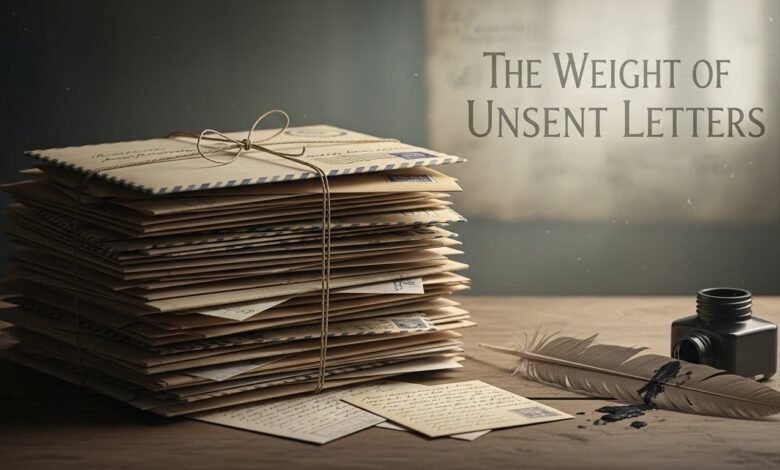
The cardboard box sat in the corner of the attic, unremarkable except for the layer of dust that marked thirty years of neglect. Maya had been sorting through her late mother’s belongings for three days, each item a small archaeology of a life she thought she knew. But this box—wedged behind Christmas decorations and her childhood art projects—held something she wasn’t prepared for Unsent Letters.
Inside were letters. Dozens of them, maybe a hundred, all addressed to the same person: Sarah Chen, 447 Oakwood Drive, Portland, Oregon. Maya’s hands trembled as she recognized her own childhood address. These letters were meant for her.


None of them had been sent.
The Woman She Thought She Knew
Maya’s mother, Ellen, had died of cancer six months ago. Their relationship had always been complicated—Ellen was distant, critical, impossible to please. Maya had spent her whole life trying to earn a warmth that never came, convinced there was something fundamentally unlovable about herself. She’d been in therapy for years, unpacking the weight of a mother who seemed incapable of affection.
But these letters told a different story.
The first one was dated March 15, 1994. Maya would have been eight years old.
My dearest Sarah,
Today you asked me why I don’t hug you like other mothers hug their daughters. You were crying, and I wanted to pull you close, but my arms wouldn’t move. How do I explain to an eight-year-old that I’m terrified? That every time I look at you, I see myself at your age, and I remember what comes next?
I’m so afraid of failing you the way my mother failed me.
Maya’s breath caught. She reached for another letter.
Unraveling the Silence
For hours, Maya sat in the dusty attic light, reading her mother’s confessions. The letters chronicled everything—Ellen’s own childhood abuse, her crippling depression, her constant fear that she would damage her daughter the way she had been damaged. Ellen had been so afraid of repeating the cycle that she’d kept Maya at arm’s length, believing distance was safer than the risk of inflicting harm.
June 2, 2003: You graduated high school today. You looked so beautiful in your cap and gown, and when they called your name, I wanted to scream with pride. But I sat quiet and still, like I always do. You deserve a mother who knows how to celebrate you. You deserve so much more than my silence.
October 17, 2008: You called today to tell me you’re engaged. I said congratulations in that flat voice you’ve come to expect from me. What I wanted to say: I’m so happy for you. I’m so proud of the woman you’ve become—kind and brave in all the ways I never was. I wanted to say I’m sorry I never taught you how to be loved because I never learned myself.
Maya’s tears fell onto the yellowed paper, blurring ink that had waited decades to be read. Her mother had loved her. Ellen had loved her fiercely, desperately, but had been so imprisoned by her own trauma that she couldn’t let it show.
The Funeral She Wished She Could Redo
Maya remembered the funeral—her dry eyes, her relief that it was over, the absence of grief. She’d thought she was mourning a relationship that never was. Now she realized she’d been mourning it her entire life.
The last letter was dated three weeks before Ellen’s diagnosis.
My Sarah,
I’m writing this one differently because I think I might finally send it. I’m seventy-four years old, and I’ve wasted so much time being afraid. A friend asked me yesterday what I regret most in my life, and the answer was immediate: you.
Not having you—you’re the only thing I’ve ever done right. But every moment I held back, every time I let fear win instead of love. Every hug I didn’t give, every ‘I love you’ that died in my throat, every time I made you feel small when you deserved to feel cherished.
I don’t know if I’ll ever be brave enough to send this, or any of these letters. But I need you to know that my distance was never about you. You were always enough. You were always everything. I was just too broken to show you.
I love you. I have always loved you.
Mom
The letter had never been sent. It sat with all the others, a museum of missed chances.
Confronting the Mirror
Maya drove to the cemetery the next morning, the box of letters in her passenger seat. She sat by her mother’s grave and read them aloud, every single one, as if Ellen could finally hear the words she’d been too afraid to speak in life.
When she finished, Maya realized something had shifted. The anger she’d carried for so long—at her mother, at herself—had transformed into something more complex. Grief, yes, but also compassion. Ellen had been a wounded person doing her best not to pass on her wounds, and in trying so hard not to hurt Maya, she’d hurt her anyway.
Unsent Letters: But now Maya understood the intention behind the pain.
Breaking the Chain
Three months later, Maya sat across from her own daughter, Lily, who was seven. They’d been having a rough morning—Maya had snapped at her over spilled cereal, and Lily’s eyes had filled with tears.
“Sweetheart, come here,” Maya said, her voice catching. Lily approached cautiously.
Maya pulled her daughter into her arms and held her tight. “I’m sorry I got angry. That wasn’t about you. Sometimes grown-ups have hard feelings from when they were kids, and those feelings can leak out in mean ways. But that’s my responsibility to work on, not yours to fix. You didn’t do anything wrong.”
Lily’s small arms wrapped around her mother’s neck. “It’s okay, Mama. I love you.”
“I love you too, baby. So, so much. And I’m going to keep telling you that every single day so you never have to wonder.”
That night, Maya started writing her own letter—not to hide in a box, but to give to Lily when she was older. A letter about grandmothers and mothers and daughters, about how pain travels through generations until someone has the courage to stop it.
She wrote about her mother’s letters, about love that existed but couldn’t find its way out, about the difference between being a perfect parent and being a healing one.
What We Carry Forward
Maya kept all of Ellen’s letters in a wooden box in her closet. Sometimes she read them, especially on hard days when she felt herself pulling away from Lily, when the old patterns whispered that distance equals safety.
The letters reminded her that silence protects no one. That unspoken love might as well not exist. That the bravest thing we can do is risk being vulnerable with the people who matter most.
She thought often about her mother—not with bitterness anymore, but with a complicated tenderness. Ellen had been trapped in her own history, but she’d been self-aware enough to document it, to leave evidence of the love she couldn’t express. Maybe that was its own kind of gift.
Maybe it was enough.
Maya made sure it was enough by finishing what her mother couldn’t. She hugged her daughter every single day. She said “I love you” so often it became a refrain. She went to therapy and broke the patterns that had broken her mother.
And on difficult nights, when Lily was asleep and the house was quiet, Maya would sometimes sit with those old letters and whisper to the woman who wrote them: “I understand now, Mom. I forgive you. And I’m going to make sure the chain ends with me.”
The past had shaped her—there was no denying that. The absence of her mother’s affection had carved deep grooves in her sense of self. But discovering those letters had given Maya something she’d never had before: context. Understanding. The knowledge that she had been loved all along, even if imperfectly.
It didn’t erase the pain, but it transformed it into something she could carry with purpose. She had been wounded, yes—but she refused to pass those wounds forward.
And in that refusal, in that daily choice to show up differently for her daughter, Maya found that the past didn’t have to be a prison. It could be a map of where not to go, a blueprint of what to do differently.
The letters her mother never sent became the most important gift Maya ever received—not despite their silence, but because of it. They taught her that love unused is love lost, that time is shorter than we imagine, and that the people we love deserve to know it, loudly and often, before it’s too late.
In the end, Ellen had found a way to show her daughter how to love after all.
Just not in time to receive it herself.
Read More: The Truth We Buried: A Story of Love and Healing