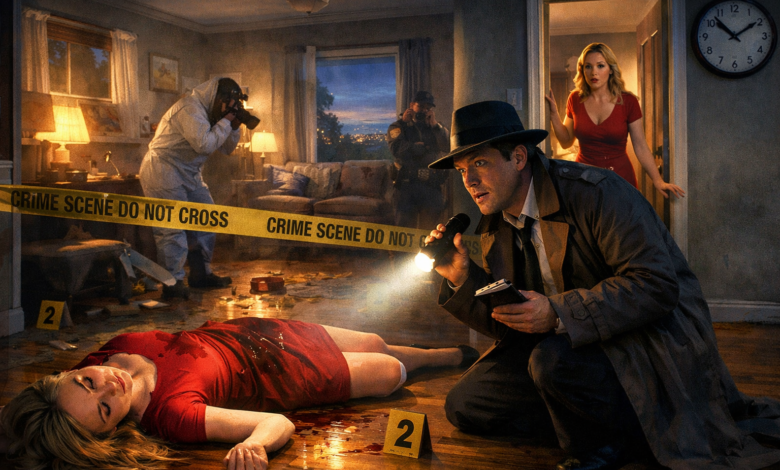
The first time I saw her body, it was laid out beneath the overpass on 9th and Calder, rainwater gathering in the hollow of her throat like a second, quieter death.
Her name was on my lips before I checked her ID.

Elena Marrow.
The sound of it scraped something old inside me.
I’d left that name behind twenty years ago, buried with a childhood I didn’t survive cleanly. Or so I thought.
The case file was thin, impossibly so. No witnesses. No murder weapon. No blood at the scene—just bruising around the wrists and a look on her face that stopped my breath. Fear, yes. But also recognition. As if she’d seen the thing that killed her long before it arrived.
I stared at the photo longer than I should have.
“You knew her?” my partner asked.
I shook my head too fast. “No.”
That was my first lie of the investigation.
I went to the morgue that night alone, driven by something I refused to name. The city hummed outside, indifferent and alive, while inside the fluorescent lights made everything look unreal—like memory.
When the attendant pulled back the sheet, my knees almost gave out.
Because the body was gone.
Not moved. Not mislabeled.
Gone.
“Elena Marrow checked out an hour ago,” the attendant said, flipping through his log. “Alive.”
I laughed once, sharp and broken. “That’s not possible.”
He looked at me like I was the strange one. “Detective, she walked out. Shaken. Confused. But alive.”
The world tilted.
I left the building in a daze, rain soaking into my coat, into my skin, into the cracks of a past I’d spent decades sealing shut.
I found her two days later in a diner on the edge of the city, hands wrapped around a coffee she hadn’t touched.
She looked older than the girl I remembered—but unmistakably her. Same scar along the eyebrow. Same way she flinched when the door opened.
She looked up.
And said my name.
Not the one I use now.
The one I was born with.
“Jonah,” she whispered.
I hadn’t heard that name since the night everything went wrong.
“You’re supposed to be dead,” I said, because it was easier than saying I’m sorry.
She smiled sadly. “So are you. In a way.”
Elena told me she’d had dreams. Vivid ones. Of dying under an overpass. Of my face above hers, not as a savior—but as a witness. Of a clock counting down days she couldn’t remember living yet.
“The dreams stopped yesterday,” she said. “And I realized something had changed.”
I already knew.
The murder hadn’t happened yet.
It was scheduled.
The closer I looked, the more the future bled through the present. Security footage timestamped three days ahead. A witness statement dated next week. A crime scene that existed before the crime.
And every thread led back to me.
To a fire twenty years ago.
To a girl I’d promised to protect.
To the night I ran.
Elena and I had grown up in the same foster home. She was eight. I was twelve. When the place caught fire, I got out.
She didn’t.
Or at least—that’s what I told myself.
The truth came back slowly, like a bruise surfacing under skin.
I had heard her screaming.
I had known where she was.
And I had still run.
She survived anyway. Burned. Scarred. Forgotten by the system.
While I reinvented myself as a man who chased justice, hoping it would outrun guilt.
The future had found a way to correct the lie I’d built my life on.
Elena’s murder was going to happen because the past demanded symmetry. Because unresolved things don’t stay buried—they wait.
The killer wasn’t a stranger.
It was the version of me that believed some sins could be outlived.
On the night the murder was meant to occur, I stood beneath the overpass before Elena ever arrived. Rain fell exactly as I remembered it from the photographs that hadn’t been taken yet.
When she showed up, panicked and confused by instincts she couldn’t explain, I stepped into her path.
“I won’t run again,” I said.
And for the first time, I meant it.
I told her everything. The fear. The cowardice. The years spent pretending that survival was the same as innocence.
The future unraveled quietly after that. No struggle. No body. No correction needed.
Some timelines don’t end with violence. Some end with truth.
Elena left the city a week later. Not forgiven—but free.
I stayed.
The case was never officially closed, because it never officially existed. But something else did.
A man finally facing the moment that shaped him.
I still investigate murders. Still chase ghosts.
But now I know this:
The past doesn’t define us by what we did when we were afraid.
It defines us by what we choose to face when fear returns.
And this time—
I stayed.
Also Read: The Shadow of Beauty A Story of Identity Self-Discovery