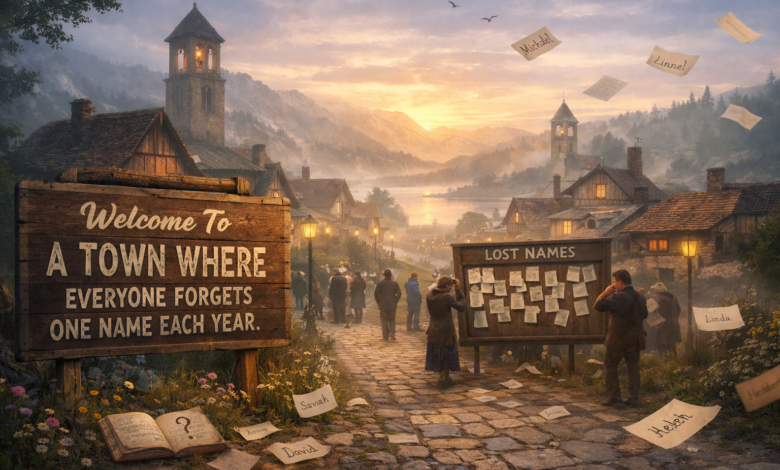
Every year, the town of Greywick gathered in the square on the first snowfall.
It was never announced with banners or bells. People simply knew. Shops closed early. Fires were lit. Children were hushed. At dusk, each resident stood silently and let go of one name.

No one chose the name. It slipped away on its own—like breath in winter.
Sometimes it was harmless. A childhood classmate. A distant aunt. Sometimes it hurt more. But by morning, the forgetting was complete. Journals blurred. Photographs felt unfamiliar. Grief dulled into a vague ache with no source.
Greywick believed this forgetting was necessary. A town cannot carry every memory forever, the elders said. Some names are too heavy.
Elara kept a list.
She hid it beneath a loose floorboard in her bedroom, written in careful ink that never wavered. Names she no longer recognized but knew she once loved. Names no one else remembered.
She did not know why she had started the list—only that the first name had appeared there fifteen years ago, written in a child’s handwriting.
Rowan.
Every year after the snowfall, Elara checked the list. Every year, one name felt heavier than the rest. Every year, she wondered why that name made her chest ache like a bruise pressed too hard.
This year, the snow fell early.
Elara stood in the square with the others, hands numb, breath shallow. She felt the familiar pulling in her mind—the gentle erosion, like waves smoothing stone.
And then she panicked.
Because the name that trembled at the edge of her thoughts was not distant or faint.
It was sharp.
Elara.
Her own name.
She clutched her coat, heart pounding. This had never happened before. The forgetting had always taken someone else.
When the moment passed, the square slowly emptied. People spoke again. Laughed, even. The ritual was complete.
Elara opened her mouth to greet a neighbor—and froze.
The word for herself was gone.
She found the list that night with shaking hands.
Names stared back at her, accusing and patient. Dozens of them. At the top, written larger than the rest, was Rowan.
Beneath it, in an older, steadier hand, was a sentence she had never noticed before:
If you’re reading this and don’t know who you are, it means you chose to forget. Now you must remember why.
Her breath caught.
Memories began to surface—not gently, but violently. A boy with dark hair and a crooked smile. Laughter by the river. Promises whispered under stars. And then fire. Shouting. A house collapsing inward on itself.
Rowan had been her brother.
No—more than that. He had been the one who discovered the truth about Greywick. About the ritual.
The forgetting was not a curse.
It was a choice.
A bargain made generations ago to survive a tragedy too terrible to remember. Each year, the town sacrificed a name to keep the full truth buried. To keep the past from demanding justice.
Rowan had tried to stop it.
He had tried to leave.
The fire had followed.
Elara fell to her knees as the final memory returned: She had agreed to forget him. To forget herself if she ever got too close to the truth again. It was the only way the elders would let her live.
The list had been her quiet rebellion. Proof that forgetting was never complete. That love leaves grooves even when names are erased.
Dawn broke pale and cold.
Elara—yes, that was her name—stood and made a decision the town had not planned for.
She would not forget again.
She gathered the list, packed her coat, and walked to the square as the bells rang for morning. People greeted her kindly, unaware of the weight she carried.
At the center of the square, she spoke Rowan’s name aloud.
The sound cracked the air.
Windows shattered. People screamed as memories flooded back—fires, lies, choices made in fear. The square filled with sobs and rage and truth long denied.
Greywick would never be the same.
Neither would Elara.
But as she walked away from the town—past the river, toward a future unburdened by silence—she knew who she was at last.
She was the one who remembered.
And this time, she would not let the past be forgotten again.
See More: A Story of Survival and Healing from Abuse