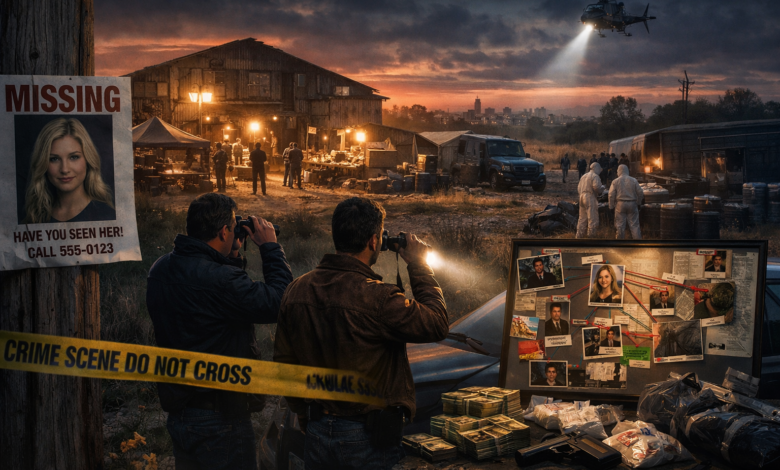
The first time Detective Laila Farooq saw the boy’s face, it was on a paper flyer that had been taped too neatly to a streetlight.
MISSING.
Rafiq Hasan, 9 years old.
A school photo—too bright, too innocent. The kind of smile that came from believing the world was safe.

His mother stood beneath the flyer, hands folded as if she was praying without knowing it. Her eyes were raw and swollen, but her voice was steady when she spoke to Laila.
“They said he wandered off,” she whispered. “My son doesn’t wander.”
Laila had learned that grief came in many languages. This woman’s came in certainty.
“Where was he last seen?” Laila asked.
“At the clinic,” the mother said. “The free one. They were giving out vitamins. Rafiq went in holding my hand. I blinked. He was gone.”
A blink.
Laila wrote it down anyway, though she had heard this before. A blink. A step behind. A crowd turning into a wall.
In the hallway of the precinct, someone offered her tea. She didn’t take it. Her throat had been tight all day, as if her body knew what her mind refused to admit: missing children were never just missing.
They were taken.
And the ones who were taken didn’t always come back.
The clinic was painted in cheerful colors meant to persuade people to trust it. Cartoon animals smiled from the walls. A hand-drawn sun beamed above a slogan: HEALTH IS HOPE.
Laila stood near the entrance where Rafiq had been last seen. She watched the way people moved—careless, eager, distracted. She watched the mothers pull children along like luggage. She watched the volunteers in matching vests offer pills and pamphlets and smiles.
Something didn’t fit.
It wasn’t the clinic itself. It was the precision of it. The way it ran like a machine in a neighborhood that couldn’t afford machines.
A volunteer approached Laila. “Can I help you, madam?”
She flashed her badge. “I’m looking into a missing child. I need your staff list.”
The volunteer’s smile flickered—brief as a blink. “Of course. We keep everything on file.”
The words sounded practiced, but the volunteer’s eyes kept drifting past Laila’s shoulder toward the back hallway. Toward a door that said STORAGE—AUTHORIZED ONLY.
Laila’s gaze followed.
“Show me,” she said.
The volunteer hesitated. It was only a second, but fear had a smell. Laila could smell it through the clinic’s minty disinfectant.
The volunteer swallowed. “It’s… just supplies. Nothing important.”
“Then it won’t take long,” Laila said, and stepped toward the door.
Behind her, the clinic’s cheerful noises continued—children laughing, mothers murmuring, a radio playing some old love song. It should’ve felt ordinary.
But Laila’s heartbeat began to quicken.
Not from instinct.
From recognition.
The storage room was neat in an unnatural way, every box labeled, every shelf dust-free. It didn’t look like a storage room.
It looked like a place someone expected to be inspected.
Laila moved between stacks of cartons marked VITAMIN C and BABY FORMULA. She kept her hand near her holster anyway.
In the back corner, she found a second door hidden behind a curtain of hanging coats.
No sign. No label.
Her stomach tightened. She pulled aside the coats and tried the handle.
Locked.
The volunteer behind her said softly, “There’s nothing there.”
Laila stared at the lock.
Then she heard it.
Not a sound, exactly—more like the absence of sound. A silence shaped like a held breath.
She knocked.
The volunteer’s voice sharpened. “Madam, please. You can’t—”
Laila knocked again, harder.
And from behind the door, a child’s voice whispered, barely audible.
“Please.”
Laila’s hands went cold.
She stepped back and kicked.
The lock snapped. The door swung open.
The air inside smelled wrong—stale and metallic, like old blood washed too many times. The room was dim, lit only by a single bulb that hummed. There were blankets on the floor. Water bottles. A plastic bucket.
And in the corner, huddled against the wall, were two children.
Not Rafiq.
Two different children, their faces smudged with dirt and tears.
Their eyes, when they saw Laila, didn’t brighten with relief.
They widened with terror.
Because adults were the ones who took them.
Because adults were the ones who lied.
Laila crouched slowly, careful with her voice the way you’re careful near an injured animal.
“It’s okay,” she said. “I’m police. I’m here to help you.”
One child shook his head violently. “They said police takes kids too.”
Laila froze.
The words struck her like a slap.
They said police takes kids too.
And just like that, the hallway of the clinic fell away and Laila was no longer thirty-two years old. She was no longer wearing a badge. She was no longer standing upright in a world that made sense.
She was eight years old again, watching her mother argue with two men in uniforms at the edge of their tiny apartment.
She remembered the heat. The smell of sweat. The way her mother’s scarf slipped as she begged.
Please. Please. He’s just a boy.
Laila remembered clutching her brother’s hand. His fingers were sticky from candy. He looked at her and smiled like he trusted her to keep him safe.
Then the men took him.
Her brother didn’t scream. He just looked confused—like a child waking from a nap, dragged into a nightmare.
Her mother had chased the vehicle until she fell.
And the last thing Laila remembered was the sound her mother made when she realized she wasn’t fast enough.
A sound like something inside a person breaking forever.
Laila had buried that memory so deep she sometimes believed it belonged to someone else. A story in her family, whispered only when the lights were off.
But now, standing in this hidden room in a clinic painted with smiling animals, the memory came back with sharp teeth.
And a question Laila had never allowed herself to ask finally rose like bile:
What if my brother hadn’t been taken by police at all?
What if they’d worn uniforms because uniforms made people look away?
Her vision blurred.
She had built her entire life on the belief that she joined the force to stop what happened to her family.
But what if she’d been chasing the wrong monster?
The volunteer was gone when Laila turned around. The hallway outside the storage room was empty.
She called for backup anyway, voice tight.
Then she did the one thing she had always avoided: she opened the file from her childhood.
Her brother’s name was Amir. Officially, he’d disappeared sixteen years ago. The case had gone cold within weeks. Her mother had died believing the state had stolen her son.
The file was thin. Too thin for a missing child.
There had been no suspects. No follow-up. Just a single note: Possible family dispute. No further evidence.
Laila stared at the words until the page trembled.
She called the only person who’d been old enough back then to remember details clearly—her aunt, who had raised her after her mother died.
Her aunt answered on the second ring. “Laila? Is something wrong?”
Laila swallowed. Her voice came out as a whisper. “Tell me again what happened the day Amir was taken.”
There was a pause, long enough to hold a whole lifetime inside it.
“Why are you asking this?” her aunt said carefully.
“I found kids,” Laila said. “Hidden. In a clinic. And… they said police take kids too.”
Her aunt inhaled sharply.
Then, softer: “Not police.”
Laila’s grip tightened on the phone. “What?”
“They weren’t police,” her aunt said, and Laila could hear a tremor in her voice, the shake of a truth held too long. “Your mother thought they were. We all did. They wore uniforms. But later… later your uncle said the badges looked wrong.”
“Why didn’t you tell me?” Laila’s voice cracked. It wasn’t anger. It was grief—fresh grief, like discovering a wound had never stopped bleeding.
“Because it destroyed your mother,” her aunt said. “Because you were a child, and you already carried enough. And because…” Another pause. “Because the men came back.”
Laila went still. “Came back?”
“They warned us,” her aunt whispered. “They said if we talked, they’d take you too. Your mother tried to fight them, and they—” her aunt’s breath hitched “—they hurt her. After that, we stayed quiet.”
Laila pressed her forehead against the cold office wall.
Her whole life had been shaped by a lie that was never meant to protect her—only to silence her.
The pain didn’t come only from the memory. It came from the fact that the memory had been edited. Sanitized. The sharp edges filed down so she could survive.
And now, the truth had returned with its edges intact.
The clinic was a doorway, not a destination.
When Laila’s team raided it that night, they found a false wall behind the storage room. A tunnel. A hidden exit that led into the alley behind the building.
No one was there.
Only the ghost of escape.
But Laila did find something else: a ledger. It was kept in a plastic folder, tucked under a loose tile—pages filled with neat handwriting and numbers.
Not money alone.
Names.
Dates.
Locations.
And beside some names, a single word:
TRANSFERRED.
Laila’s hands shook as she turned the pages.
Rafiq Hasan was on it.
But so was another name.
A name that made the room tilt.
Amir Farooq.
Her brother.
Transferred.
Sixteen years ago.
At first, Laila couldn’t breathe. She heard her own heart pounding, loud as a siren.
Then a new thought formed, terrifying and incandescent:
Amir might still be alive.
If he’d been transferred, that meant he’d been moved—sold, smuggled, placed into someone else’s hands.
He hadn’t simply vanished.
He’d been processed.
And someone had made a profit from turning a child into a commodity.
Laila’s badge suddenly felt like lead. Her life’s purpose—justice, protection, truth—felt fragile against the machinery of what she was seeing.
But beneath the fear, something else rose.
Not hope.
Fury.
A fury so clean it steadied her hands.
They had taken her brother.
They had taken her mother’s sanity, her mother’s life.
They had taken dozens of children from families who had nothing but love.
And now they had taken Rafiq.
Laila knew what this was.
A criminal network disguised as charity.
A pipeline hidden behind cartoon murals and free vitamins.
A system that wore kindness like a costume.
The next weeks were a blur of long nights and broken doors and whispering informants who refused to meet under streetlights. Every time Laila thought she had the network, it shifted—moving its clinics, changing its names, replacing volunteers like shedding skin.
She followed the ledger to warehouses that smelled of bleach and fear. She followed it to shell companies registered in dead men’s names. She followed it to “orphanages” that weren’t orphanages at all—just holding pens with clean beds and locked windows.
And everywhere, she found traces of her brother’s past.
A shipment list that mentioned his name next to a city he’d never lived in.
A photograph, blurry, of a group of children lined up for “medical checks”—one of them with hair the same black curl as hers.
A coded message intercepted on a burner phone:
Amir’s batch was successful. Donors satisfied. Keep operations quiet.
The word donors made Laila sick.
She began to realize how large the network was—not just criminals with knives in dark alleys, but men in suits, people with polished smiles and philanthropic speeches. People who smiled for cameras while children cried in hidden rooms.
A network that fed on respectability.
One night, after a raid, Laila sat alone in her office with the case files spread around her like a map of suffering.
She stared at Amir’s name until it stopped looking like letters and started looking like a scar.
She remembered how, as a child, she had decided to become someone strong enough to stop the world from taking what she loved.
But she had done it by forgetting.
By burying the past so she wouldn’t collapse under it.
Now she understood something terrifying:
Forgetting hadn’t protected her.
It had protected them.
The network thrived because everyone who was hurt learned to stay quiet.
Learned to swallow grief.
Learned to call it fate.
Laila stood up.
And she made a decision.
Not just to solve Rafiq’s case.
But to burn the entire system down.
The breakthrough came from an old man who sold tea at the edge of the city.
Laila found him because she was desperate enough to chase rumors, desperate enough to follow the ledger to a name written in the margin like a footnote: Haji Noor.
The tea seller’s hands shook as he poured for her. His eyes were cloudy, as if he’d seen too much.
“Why are you asking about those people?” he murmured.
“Because they have children,” Laila said.
The old man stared at her badge. “Badges don’t mean anything.”
“They mean something to me,” she said.
He laughed bitterly. “Badges are masks. They wore masks even back then.”
Laila’s mouth went dry. “Back then?”
The old man leaned in. “I saw the boy.”
Laila’s heart slammed. “Amir.”
He nodded. “They brought him here for one night. He cried for his sister. Said her name over and over.”
Laila’s vision blurred. “Did you see where they took him?”
The old man hesitated. Then, like a man choosing between two kinds of death, he spoke.
“There is a house,” he whispered. “Outside the city. They call it the Orchard. They bring children there before they go… elsewhere.”
Laila’s hands clenched so hard her nails dug into her palms. “Elsewhere.”
The old man’s voice was almost inaudible. “Places where money is thicker than blood.”
The Orchard wasn’t a house.
It was a fortress disguised as one—tall walls, guards, cameras, a gate with a painted sign that read: PRIVATE PROPERTY. DO NOT ENTER.
Laila didn’t wait for permission.
She led the raid herself.
The gate came down under the force of the armored vehicle, crashing like a promise kept. Guards shouted. Shots rang out. Laila moved through it all with a focus that felt like walking through fire.
Inside, she found rows of rooms with neat beds. Shelves of medications. Lockers full of uniforms—clinic vests, police outfits, delivery shirts.
Masks.
All the masks they used to blend into the world.
In the main building, there was a basement.
Laila knew it was there before she saw it.
The air changed near the stairwell. Grew heavier. Thick with panic that never truly left.
She went down.
The basement held children.
Dozens.
Some sat silently, eyes dull with exhaustion. Some cried. Some stared at her like she was just another mask.
Laila knelt in front of a girl whose wrists were bruised. “Where’s Rafiq Hasan?” she asked gently.
The girl’s lips trembled. “They took him upstairs. For… for the phone.”
“What phone?”
The girl’s eyes filled with tears. “The one where they show people… and people choose.”
Laila’s blood turned to ice.
A marketplace.
A catalog.
A world in which human beings became items.
Laila stood up, shaking.
And then she heard a voice behind her.
A man’s voice, calm and amused.
“You’re making quite a mess, Detective.”
Laila turned.
The man wore a suit, perfectly tailored, not a hair out of place. His smile was almost kind.
He held a phone in his hand.
And on the screen—
Rafiq’s face.
Crying.
Held by someone off-camera.
The man’s voice softened. “This is how it works. You don’t understand the world you’re trying to fight.”
Laila’s hand went to her gun. “Where is my brother?”
The man tilted his head, as if genuinely curious. “Your brother?”
Laila stepped forward. “Amir Farooq. Sixteen years ago. Transferred.”
The man’s smile widened. “Ah,” he said. “So that’s what this is.”
Laila’s breath hitched.
He looked at her with new interest, as if she’d become a more entertaining problem.
“You should thank us,” he said. “You wouldn’t be who you are without what happened. Your pain made you ambitious. Your grief made you brave. We carved you into a weapon, Detective. We—”
Laila fired.
The bullet shattered the phone in his hand.
The man staggered, eyes wide—not from pain, but shock. He had believed he was untouchable.
And then Laila did something that surprised even herself.
She didn’t shoot again.
She stepped close, close enough to smell his cologne, and she said, voice trembling with a kind of clarity she had never known:
“You didn’t carve me into anything. You broke my family. And I survived anyway.”
The man’s smile faltered. “Your brother is dead,” he spat suddenly, cruelty flashing like a blade. “They don’t keep old inventory.”
Laila froze.
Her chest cracked open.
For a moment, she was eight again.
For a moment, she was her mother, begging.
But then she looked around her.
She looked at the children, all the stolen futures sitting in rows like forgotten prayers.
And she realized something:
Even if Amir was gone, the story didn’t end with him.
It ended with what she did next.
Rafiq was found alive in a locked room upstairs, drugged and crying but breathing. When Laila carried him out, his small hands clutched her jacket like a lifeline.
Outside, dawn broke over the city, pale and exhausted.
Ambulances came. Social workers. Cameras. Officials who suddenly cared because someone important had been caught.
The man in the suit was arrested. But Laila knew he wasn’t the whole network—only one face.
Still, it was a beginning.
In the weeks that followed, names unraveled like knots. Clinics were shut down. Orphanages were raided. Officials resigned, some in disgrace, some in silence. A country that had been taught to look away was forced to look.
And Laila—Laila didn’t go home the way she used to.
She went to her mother’s grave.
The cemetery was quiet, the air cool. She knelt, brushing dust off the stone.
Her mother’s name stared back at her.
Laila placed a hand on the grave and finally let herself remember everything she had tried to bury: her brother’s sticky fingers, her mother’s desperate sprint, the sound of that breaking.
Tears came, and she didn’t stop them.
“I didn’t save him,” she whispered. “I couldn’t.”
The wind moved through the trees, as if the world exhaled.
Laila took a shaking breath.
“But I saved others,” she said. “And I’m going to keep saving them. I’m going to make sure no one ever has to live with a silence like ours again.”
For the first time in her life, she felt the past loosen its grip—not disappearing, not forgiving, but transforming.
It wasn’t a chain anymore.
It was a compass.
It pointed her forward.
Months later, a letter arrived at the precinct. No return address.
Inside was a single photograph.
A group of young men standing together, older now, faces hardened by years. The photo had been taken in another country; the background was unfamiliar.
On the back, in rough handwriting, were two words:
FORGOTTEN BOYS.
And beneath that, a name:
Amir.
Laila stared until the ink blurred with her tears.
It wasn’t proof. It wasn’t certainty.
But it was something she hadn’t allowed herself in sixteen years.
A possibility.
A future that still had room for him.
She folded the photograph carefully, like handling something sacred.
Then she stood, straightened her badge, and walked back into the world.
Not because she believed she could fix everything.
But because she no longer believed she had to carry her pain alone.
Because she had finally confronted the truth, and the truth—sharp as it was—had given her back her voice.
And with her voice, she would make sure the missing were never erased again.