The rain had been falling like a confession all night—steady, relentless, washing the city in a gray that made streetlights look tired. Yusuf hated nights like this, not because of the weather, but because the wet pavement reflected everything back at you. Every neon sign. Every passing face. Every regret you thought you’d already driven past.
His taxi smelled faintly of cardamom and old upholstery, the kind of scent that clung to fabric no matter how often you aired it out. The meter ticked softly even when there was no passenger, a nervous habit of the machine’s tiny gears. Yusuf kept his hands at ten and two, as though holding the steering wheel correctly could keep his life from drifting.


It was 2:37 a.m.
He’d promised himself he’d stop after this shift. He’d promised that a hundred times. Promises, Yusuf had learned, were like coins. You made them with good intent, and then spent them on survival.
The radio was low, a crackling lullaby. A voice droned about traffic that didn’t exist at this hour, about roads slick with rain, about caution. Yusuf wasn’t listening. He was staring at his own reflection in the windshield—two eyes floating in the dark like a man haunted by his own face.
Then he saw her.
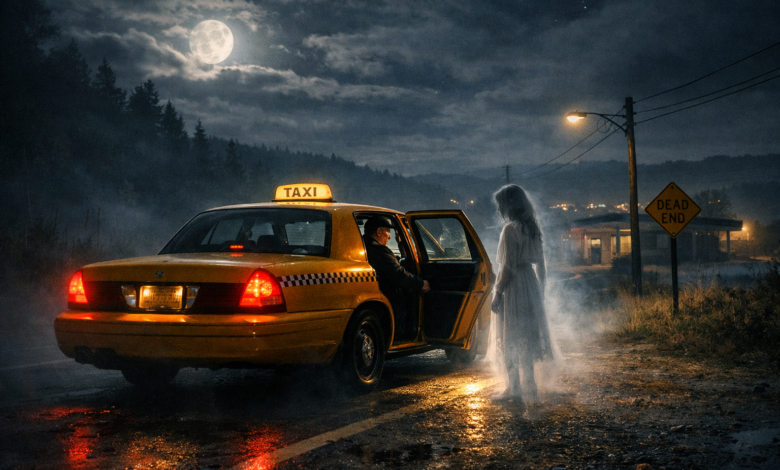
At first, she was just a silhouette at the curb beneath a broken streetlamp—a woman standing too still in the rain, her clothes untouched by wetness, her hair neat as if the night hadn’t tried to ruin her. No umbrella. No phone. No impatient shifting of weight like everyone else who waited for a ride. Just… waiting. Like she’d been placed there.
Yusuf slowed without deciding to.
His gut tightened, the way it did when a memory tried to crawl up from where he’d buried it.
She lifted her hand.
Not a frantic wave. Not a beckon. Just the simplest gesture: stop.
His foot hit the brake.
The taxi rolled to the curb and sighed to a halt. Yusuf leaned over and unlocked the rear door automatically, the click sounding loud in the quiet.
She opened the door and slid in.
The interior light came on and for half a second everything was ordinary: pale leather seats, dangling prayer beads on the mirror, a young woman in the back wiping her hands on her coat.
Except… her coat was dry.
Yusuf glanced at the rearview mirror and felt his throat close.
He knew that face.
Not because it was famous. Not because it belonged to someone he’d loved in the usual way.
Because it was the face of a life he’d abandoned.
Her eyes met his in the mirror.
Brown, steady, impossibly calm.
“Good evening,” she said, voice soft as breath on glass. “You’re still driving.”
Yusuf’s fingers tightened around the wheel until his knuckles whitened. His mouth opened, but nothing came out. He tasted copper, like he’d bitten his tongue.
He hadn’t heard that voice in fifteen years.
Not since the night he’d stopped answering his phone.
Not since the night he’d told himself there was no point in going back.
Not since he’d convinced himself that leaving was the only way to survive.
“Where to?” he managed finally, because the question was a shield. It was something drivers said. A ritual. A way to keep from saying the wrong truth.
She looked out the window at the rain-streaked city, as if recognizing it.
“Home,” she said.
Yusuf swallowed. “Where’s home?”
She turned her head slightly, and the interior light caught her profile in a way that made Yusuf’s chest ache. “You know.”
The meter began to tick again, impatient and precise.
Yusuf’s hands trembled as he put the car into gear.
He told himself he would drive for five minutes, drop her wherever she wanted, and pretend none of it happened. He told himself it was just exhaustion. A hallucination. The kind of trick the mind played when you were too tired and too lonely and too full of old ghosts.
But the city started to shift around them.
Not in the way of magic—no glittering transformations, no sudden impossibilities. Just small distortions. Street names changed. Buildings appeared where Yusuf swore empty lots had been. The air smelled suddenly of dust and chalk and the faint sourness of fear.
He recognized the route before he admitted he did.
A familiar road, narrower than he remembered. A neighborhood he hadn’t visited since he was a boy with scraped knees and a mother who still believed in him.
His breath turned shallow.
“Why are you here?” he asked, his voice rough.
In the mirror, her expression didn’t change. “You picked me up.”
“I didn’t—” Yusuf stopped himself. He had. He had seen her and stopped, like he was being pulled by a rope tied to something deep inside him.
He forced a laugh that sounded broken. “I mean… you can’t be here.”
She watched him like someone waiting for the rest of the sentence.
“You’re…” The word refused to come. Not because he didn’t know it, but because saying it would make it real.
She finished it for him. “Dead?”
Yusuf flinched so hard the taxi swerved slightly, tires hissing on the wet road. His heart punched his ribs.
“She’s dead,” Yusuf whispered to the steering wheel. “You’re dead.”
The woman in the backseat looked away again, as if giving him privacy with his grief.
“I am,” she said quietly. “And you’re alive.”
Yusuf’s eyes burned. “Then why?”
Silence. The kind that filled the whole car. The kind that made the world outside feel far away.
Finally, she spoke.
“Because you keep driving past the same place, Yusuf. Every night. You circle it like an animal circling a wound, but you never stop.”
Yusuf’s hands tightened. “I don’t know what you’re talking about.”
She let out a small breath, almost a laugh, except there was no humor in it. “You always said that when you didn’t want to face something. I don’t know. I don’t remember. It wasn’t my fault.”
The words hit him like thrown stones.
“I was sixteen,” Yusuf said sharply. “I was a kid.”
“You were old enough to choose,” she replied, and her voice was still soft, but now it carried something heavier. “Old enough to walk away.”
Yusuf’s vision blurred. Rain, he told himself. Just rain.
But it wasn’t.
The road ahead narrowed into the street he’d tried to erase from his mind. The street where his old house still stood in his memory—peeling paint, a crooked gate, the sound of his mother humming as she cooked, the smell of lentils and heat.
The street where the accident happened.
His foot hovered over the brake. He wanted to turn. He wanted to take the next left and be anywhere else.
But the car didn’t turn.
The steering wheel felt heavier, as if the taxi itself had decided.
“Stop,” the woman said gently.
Yusuf’s breath came in a ragged hiss. “No.”
“Stop.”
“Why are you doing this?” His voice cracked. “Do you want me to suffer? Haven’t I suffered enough?”
In the mirror, her eyes softened in a way that made Yusuf want to look away.
“I don’t want you to suffer,” she said. “I want you to stop running.”
The streetlamp on the corner flickered as they approached it.
And then Yusuf saw it—his old house, exactly as he remembered, crouched in the dark like something waiting. The same crooked gate, the same cracked sidewalk. Even the neighbor’s fig tree, dripping rain, heavy with fruit.
His chest constricted so tightly he thought he might vomit.
He pulled over. The taxi stopped.
The meter stopped ticking.
Outside, the rain softened to a hush, like it too was listening.
Yusuf sat frozen. His palms were slick. His mind was screaming.
Don’t look. Don’t go. Don’t reopen it.
Behind him, the passenger’s door opened. Not with a squeal of hinges, but silently, like it had always been open.
“Come,” she said.
Yusuf didn’t move.
“I can’t,” he whispered.
“You can,” she replied, and there it was—the tone his sister used when he cried as a child. Firm, patient. “You’ve done harder things than walk through a door.”
He squeezed his eyes shut.
Memory came anyway, unstoppable.
The night she died wasn’t rain-soaked like this one. It was summer, thick and breathless. Yusuf remembered the heat, the buzzing of flies, the argument in the kitchen.
His father’s voice like thunder: You think you can leave? You think you’re better than us?
Yusuf’s own voice, sharp and trembling: I’m going to Karachi. I’m going to stay with Uncle. I’m done.
His mother crying.
His sister—little Mariam—standing in the doorway, too young to understand why everyone was breaking apart.
Yusuf remembered grabbing his bag. He remembered slamming the door. He remembered the feeling of the world opening up, the intoxicating thrill of escape.
He remembered the sound behind him.
A screech of tires. A shout. The sickening, dull impact.
And then the silence.
He had told himself—no, he had decided—that it wasn’t his fault. That he hadn’t pushed her. That he hadn’t told her to follow him. That he hadn’t turned around.
But he had.
In his memory, the moment unfolded in slow motion: Mariam running after him barefoot, crying his name, desperate not to be left behind. Yusuf turning, furious and scared and full of poison, and snapping—
“Go back inside!”
His hand, outstretched, shoving her away from him.
Not hard. Not meant to harm.
But enough.
Enough that she stumbled off the curb.
Enough that the delivery bike swerved too late.
Enough that her small body hit the road and then didn’t move.
Yusuf opened his eyes.
His throat made a sound like an animal.
In the backseat, Mariam waited.
Not accusing. Not cruel.
Just… there.
Yusuf forced his door open. His legs shook as he stepped out into the rain, which suddenly felt cold on his skin, real and punishing. His shoes sank slightly into the wet earth of the curb.
He stood before his childhood gate.
He hadn’t come back for the funeral. He hadn’t come back for his mother. He hadn’t come back for anyone.
He’d sent money. He’d called sometimes. He’d listened to his mother’s voice grow older and thinner until the calls stopped.
But he hadn’t returned.
Because the street held Mariam’s blood in his mind, and he couldn’t bear to see it again.
The gate creaked as he pushed it open.
The yard smelled like damp soil and jasmine.
The front door was shut.
He reached for the handle.
His hand hovered.
From behind him, Mariam’s voice floated like a prayer.
“You always wanted to be forgiven,” she said. “But you never wanted to be known.”
Yusuf’s chest broke open.
“I’m sorry,” he whispered, not to the door, not to the empty house, but to the years of silence he’d built like a wall. “I’m sorry. I’m sorry.”
The words didn’t feel like enough. They never would.
He turned toward the taxi.
Mariam stood beside it, rain still not touching her. Her eyes held the same calm, but now Yusuf saw the sadness underneath. The sadness of a child left behind in a moment too big for her.
“I didn’t mean to,” Yusuf cried. The sound tore out of him. “I didn’t mean to. I was angry. I was scared. I thought if I left, I could become someone else. I thought if I ran far enough, the truth would… disappear.”
Mariam stepped closer.
And for a moment, Yusuf smelled something that didn’t belong to this night—the faint scent of talcum powder and warm bread, the scent of a girl who used to press her face into his shoulder when she was tired.
“You did become someone else,” she said gently. “A man who carries me everywhere and calls it living.”
Yusuf sobbed. He pressed his hands to his face. “Tell me how to stop,” he begged. “Please. Tell me what to do.”
Mariam’s eyes shone, not with anger, but with something that looked almost like mercy.
“You don’t get to erase what happened,” she said. “But you do get to choose what happens next.”
Yusuf looked at her through his tears.
“What next?” he whispered.
“Go back,” she said. “Not to this house. To the people you left. The ones who still wake up with your absence like a bruise. Tell them the truth. Tell them you were a coward. Tell them you’re sorry. Let them see you.”
Yusuf’s heart clenched. He thought of his mother’s face, older now. He thought of the messages he’d never answered, the numbers he’d blocked when grief felt too sharp. He thought of how he had turned his life into a long night shift so he wouldn’t have to go home to himself.
“And if they don’t forgive me?” he asked, voice raw.
Mariam smiled, small and sad. “Then you will finally be honest without demanding a reward.”
The rain fell harder, as if the world had decided to start again.
Yusuf wiped his face with trembling hands. He stood straighter.
In the taxi, the seat where Mariam had sat was empty.
The rear door was closed.
The interior light was off.
For a moment, panic surged—had he imagined it? Had his mind broken?
Then he saw something on the backseat.
A small, worn hairclip, shaped like a star.
His chest seized.
He remembered that clip. Mariam had worn it when she was seven. Yusuf had bought it for her with coins he’d saved, proud as if he’d bought her the moon.
His fingers closed around it.
It was warm.
Real.
The meter flicked on by itself.
Not ticking.
Just a steady, patient glow.
Yusuf got back into the driver’s seat and stared at his hands on the wheel. They looked older than they should. They looked like hands that had gripped the same escape route for years.
He put the car into gear.
This time, he didn’t circle the neighborhood. He didn’t drive away like he always had.
He drove forward.
Out of the old street. Out of the loop.
He headed toward the highway that would take him to the bus station.
To the city where his mother lived now, with relatives, in a smaller house and a smaller life.
His phone sat in the console, screen dark.
Yusuf picked it up. His thumb hovered over the contact he hadn’t dared to call in years: Ammi.
His heartbeat thundered.
He pressed Call.
The line rang.
Once.
Twice.
Three times.
He nearly hung up.
Then the call connected, and a voice—thin with sleep and age—answered.
“Hello?”
Yusuf’s breath hitched. His eyes filled again, but these tears were different. Not the helpless flooding of grief, but the painful thaw of something frozen too long.
“Ammi,” he whispered. His voice broke on the word. “It’s me.”
There was silence. A pause that held fifteen years in it.
Then, so softly Yusuf almost didn’t hear it, his mother’s voice trembled.
“Yusuf?”
He gripped the steering wheel with one hand and the phone with the other, as if holding onto both worlds.
“Yes,” he said, and the truth came with it, unstoppable now. “It’s me. I’m coming home. And I have to tell you something. I have to tell you everything.”
Outside, the city lights blurred into a river of gold.
Behind him, somewhere in the backseat, the air felt lighter.
Yusuf drove on through the rain, not trying to outrun his past anymore, but carrying it honestly, like a scar you finally stop hiding.
And for the first time since he was sixteen, the road ahead did not feel like escape.
It felt like a beginning.
Also Read: The Shadow of Beauty A Story of Identity & Self-Discovery