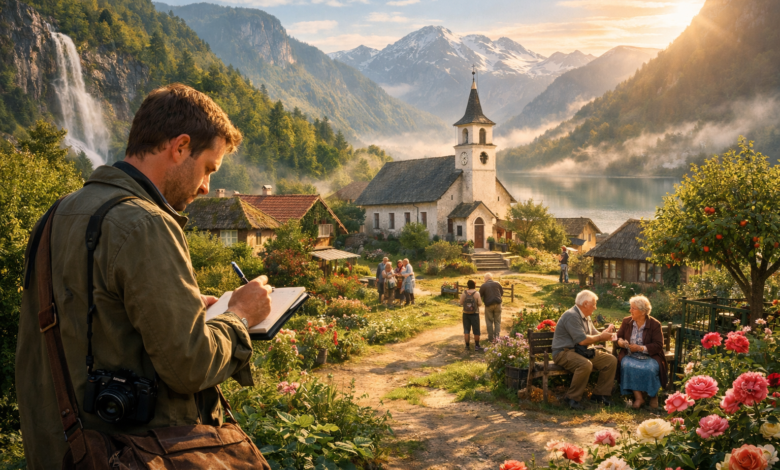
The town was called Holloway, and it sat in a fold of hills like a held breath.
For two hundred years, no one had died there.

That was the line that had pulled Mara Ellison out of her apartment and onto the narrow road that curved through ash trees and stone fences. It was the sort of claim editors loved to kill—too neat, too mythic—but her editor hadn’t laughed. He’d gone quiet, then said, Go see it. If it’s fake, prove it. If it’s not… bring me the why.
Mara parked near a white church with no cemetery.
That was the first wrong thing.
Towns had graveyards the way bodies had scars. Holloway had neither.
She stepped out of the car with her notebook, the old one with the torn spine, the one she carried when she didn’t trust herself to remember. The air smelled like rain and apples. Somewhere a bell rang—not from the church, but from deeper in town, a slow single toll that felt less like timekeeping and more like a pulse.
A woman waved from the porch of the general store. “You must be the reporter.”
Mara nodded. “Mara Ellison.”
“I’m Ruth Calder. I’m on the council.” Ruth’s smile was warm, practiced. “We’ve been expecting you.”
That was the second wrong thing.
They gave her the tour. School. Clinic. Records office. Everyone was healthy, if not young. Faces bore age but not frailty. No one limped. No one coughed. When Mara asked about accidents, illness, childbirth—Ruth answered smoothly.
“We get sick,” she said. “We heal.”
“Everyone?” Mara pressed.
Ruth’s eyes flickered, just once. “So far.”
The records office smelled of paper and lemon oil. Shelves stretched wall to wall, ledgers labeled by year. Mara ran her finger down the spines—1826, 1827, 1828—until her hand stilled.
There was a gap.
“1839 is missing,” Mara said.
Ruth closed the ledger she’d been holding. “That was a fire. Lost some things.”
“How many?”
“Enough.”
Mara wrote it down.
That night, she stayed at the inn, a narrow bed and a window that looked toward the hills. She dreamed of water.
Not a lake. A river, swollen and fast. A child’s shoe tumbling end over end. She woke with her heart racing and the taste of iron in her mouth.
She hadn’t dreamed of the river in years.
Mara had been sixteen when her younger brother Jonah drowned.
Everyone said it was an accident. Slippery rocks. Sudden current. But Mara remembered the argument—the way she’d shoved him away when he grabbed her arm, the flash of hurt on his face as he lost balance. She’d never told anyone that part. She’d buried it so deep she’d almost convinced herself it wasn’t real.
Almost.
In Holloway, memories came back sharp, uninvited.
The next day, she spoke to the oldest resident she could find. Elias Morren was one hundred and three, according to Ruth, and still split his own firewood.
“People don’t die here,” Mara said, sitting across from him on a bench overlooking the fields. “Why?”
Elias watched the clouds drift. “Because we remember.”
“That’s not an answer.”
He smiled sadly. “It’s the only one that matters.”
That afternoon, a boy fell from a ladder outside the school.
Mara saw it happen. Heard the crack as his head struck stone.
Screams. Running feet.
She pushed through the crowd, heart hammering. The boy lay still, blood darkening his hair.
Then he gasped.
Color returned to his face like a tide reversing. Bones shifted, skin knitting. Within minutes, he was sitting up, dazed but alive.
No ambulance. No prayers. Just relief—and something else in the eyes of the adults. Not surprise.
Recognition.
Mara’s hands shook as she wrote.
That night, Ruth knocked on her door.
“It’s time,” she said quietly. “You’ve seen enough.”
They took her to the hills, to a stone building half-swallowed by ivy. Inside, candles lined the walls, their flames steady despite the draft. At the center stood a pool of dark water, still as glass.
“This is where we keep it,” Ruth said.
“Keep what?”
“Death.”
Mara laughed, sharp and disbelieving. “That’s not possible.”
Ruth looked at her with something like pity. “You already know it is.”
Elias emerged from the shadows, leaning on his cane. “Two hundred years ago,” he said, “Holloway was like any other town. We buried our children. We mourned our parents. And then one winter, the river froze so hard it cracked houses in half. Dozens died. We couldn’t bear it anymore.”
“So you made a deal,” Mara said. “With what?”
“With ourselves,” Ruth said. “We found a way to carry death instead of letting it take us.”
They explained it slowly, carefully, as if Mara might break.
When someone in Holloway should die, they didn’t—not truly. The death was held, transferred into the pool, into the town’s memory. Pain, finality, endings—absorbed and stored. The town aged, but it didn’t lose.
“But nothing is free,” Mara said.
“No,” Elias agreed. “Every generation, someone comes who can take the weight.”
Mara felt cold. “Take it how?”
Ruth met her gaze. “By remembering what others cannot.”
The pool stirred. Images rippled across its surface—faces, moments, endings. Hundreds of deaths, layered and waiting.
“You’re saying someone has to carry all of this,” Mara whispered.
“Yes.”
“And if they don’t?”
Elias’s voice was barely audible. “Then it all comes back at once.”
Mara stepped back. “Why are you telling me this?”
Ruth reached into her pocket and withdrew a folded page. A newspaper clipping, yellowed and soft.
LOCAL TEEN DROWNS IN RIVER TRAGEDY.
Jonah’s name stared back at her.
Mara’s breath caught. “How did you—”
“You didn’t come here by chance,” Ruth said gently. “Holloway calls people with unfinished deaths. People who carry them already.”
Mara’s legs gave out. She sank to the stone floor, memories crashing in—the shove, the scream, the water closing over Jonah’s head.
“I killed him,” she said.
“No,” Elias said. “You survived him. There’s a difference.”
Tears burned her eyes. “I’ve been running from it my whole life.”
Ruth knelt beside her. “We think you’re meant to stop.”
The truth settled in her bones, heavy and inevitable. The town didn’t have zero death records because no one died.
It was because someone else always did.
The choice was simple and unbearable.
If Mara accepted, she would become Holloway’s keeper. She would hold every ending, every pain, so the town could continue untouched. She would live—but never lightly.
If she refused, the pool would empty. Two centuries of deferred death would rush back into the world.
Children. Elders. Everyone she’d spoken to.
Mara thought of Jonah. Of how she’d spent years pretending the past couldn’t reach her if she didn’t look back.
She stood and walked to the pool.
The water reflected her face—lined, tired, afraid. She placed her hands on the surface.
The memories surged.
She screamed as they entered her—fire, fever, falling, last breaths layered over last breaths. She felt bones break that weren’t hers, hearts stop that didn’t belong to her body. She felt Jonah again, the river cold and unstoppable.
And then—stillness.
Mara collapsed, sobbing, but alive.
Outside, Holloway slept on, untouched.
Months later, Mara left town.
She didn’t write the article. Some truths weren’t meant for print.
She moved closer to the river she’d avoided for years. Some nights, the memories were unbearable. But she was no longer running.
She began to volunteer with families who’d lost someone—really lost someone. She listened when they spoke. She remembered for them, too, in her own way.
The past had shaped her into someone who carried weight.
Confronting it made her choose what to do with that strength.
And far away, in a quiet town with no cemetery, the bells kept ringing—slow, steady, alive—because one woman had finally stopped running from death, and in doing so, had learned how to live.
Also Read: The Weight of Unsent Letters A Story of Forgiveness