The first time Mira noticed the camera, it wasn’t because of the red light.
It was because of the shadow.

The monitor sat on the counter of the all-night security office, its screen divided into neat squares—hallways, elevators, stairwells—each one a quiet box of fluorescent light and emptiness. Mira had been hired two weeks ago to watch a building that barely needed watching: an old municipal archive, all concrete ribs and locked doors, the kind of place where history was filed and forgotten.
She’d been told it was an easy job.
“Nothing ever happens here,” her supervisor said, sliding the keycard across the desk. “If you get bored, bring a book.”
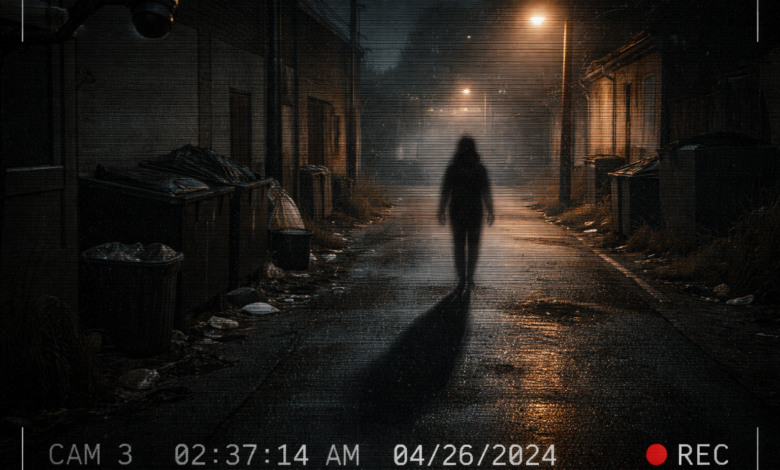
Mira did get bored. She drank lukewarm coffee and listened to the building breathe: vents sighing, pipes clicking as they warmed and cooled, the occasional groan of the elevator cables like an animal shifting in its sleep. The cameras showed her what she already knew—nothing, always nothing—until one night, at 3:17 a.m., something moved across the screen.
Not a person.
A shadow.
It was on Camera 12, the corridor outside the restricted basement stacks. The light there was harsher than the others, a strip of white that made every edge sharp. A door sat at the end of the hall, bolted and sealed. No one was supposed to go down there. Mira knew that. She’d signed the paperwork. She’d watched the training videos. She’d heard the warnings.
And yet, on the monitor, a shadow crossed the hall as if someone walked through the light.
It was the shape of a person—slender, upright, moving at a steady pace. It had shoulders. It had a head. It swung its arms the way a tired person does when they’re walking alone.
But there was no body attached.
No footsteps echoed through the building. No keycard beeped. No door opened.
Just the shadow, gliding across the linoleum, dark as ink, then vanishing where the hall bent out of frame.
Mira leaned closer to the screen, the hair on her arms rising like static.
She hit rewind.
There it was again. 3:17 a.m. The shadow appeared at the edge of the frame, crossed the strip of light, and disappeared. Not jittery like a glitch. Not warped like a compression artifact. Smooth. Intentional. Like someone who knew exactly where they were going.
Mira replayed it five times, each time expecting her mind to finally catch up and label it nothing. A trick. A bug. A weird reflection.
But her chest had started to hurt, a slow tightening that felt familiar in the ugliest way.
Because she recognized the way it walked.
The slight inward turn of the left foot.
The careful swing of the right arm, as if protecting an old injury.
It was a walk she’d seen in mirrors without meaning to—seen in photos she avoided, seen in dreams that left her sweating.
It was the way her father used to walk when he came home late and didn’t want to wake her.
Mira sat back so fast her chair squealed. The sound was too loud in the office, like an accusation. She stared at the other camera feeds, as if the building might reveal something else—something that would make this feel less… targeted.
Outside, rain ran down the windows in pale threads. Streetlights turned it silver.
Inside, the monitor flickered.
Camera 12 went briefly snowy, then cleared.
At 3:18 a.m., the shadow appeared again.
This time, it paused in the center of the hall, right in the brightest part of the light.
As if it knew she was watching.
Mira’s mouth went dry. Her fingers hovered over the radio, the emergency button, the phone. She could call her supervisor. She could call the police. She could call anyone.
But her hand didn’t move.
Because her father had died twelve years ago.
Because her father’s funeral had been a closed casket, and the man who had raised her had never been truly seen by her again—not in a hospital room, not in a final moment, not even in the quiet, ordinary way grief allows you to say goodbye.
Because she had never been allowed that.
Because she had taken it from herself.
The shadow lingered for a second longer, then continued, disappearing toward the basement door.
Mira’s heart hammered so hard she thought the camera might pick it up. She watched the empty corridor, waiting for something else to happen.
Nothing did.
Camera 12 showed only light and locked doors.
But Mira could no longer breathe like a person who believed in locked doors.
She told herself she wouldn’t go down there.
She said it out loud, the words bouncing off the walls of the security office like they belonged to someone braver.
“I’m not going down there,” she whispered. “It’s nothing.”
But the building listened. The building waited.
At 3:19 a.m., the lights on Camera 12 dimmed. Not out. Just lower. As if someone had turned down the world by a few notches. The corridor became less harsh, softer, like a memory losing its edges.
Then, on the monitor, a figure stood where the shadow had been.
Not a person.
A silhouette.
A solid darkness shaped like a man.
The lights behind it shone through nothing.
Mira’s breath caught. She felt twelve years collapse into the single space between her and the screen.
The figure lifted one arm.
Not a wave. Not a threat.
A gesture like knocking on glass.
Once.
Twice.
Three times.
Then the feed cut to black.
Mira shot to her feet so quickly her coffee toppled. It spilled across the desk, brown and steaming, like blood that wasn’t blood. She didn’t care. She didn’t even look.
Her radio crackled softly.
A voice came through.
Not her supervisor. Not dispatch.
A man’s voice, low and roughened by years.
“Mira.”
Her name.
Spoken with the gentleness of someone who once whispered it at bedtime.
Her knees went weak. She clutched the edge of the desk to stay upright.
The radio crackled again.
“Mira,” the voice repeated. “You can’t keep leaving me down there.”
Mira pressed her palm to her mouth, biting down on a sound that wanted to tear out of her. Her body had already decided this was real—her body always remembered what her mind tried to forget.
“No,” she whispered, shaking her head. “No, that’s not—”
The radio hissed.
“Come.”
It wasn’t an order. It was a plea.
Something in her broke loose—not a belief, but a held breath. A thread that had been wound tight for twelve years and had finally snapped.
Mira grabbed her flashlight, her keyring, her jacket.
She didn’t call anyone.
She didn’t turn on the office lights.
She walked out into the empty building like someone going to meet a sentence they had postponed.
The archive at night was a cathedral for paper.
Rows of shelves rose like pews. Long corridors stretched between them, lit by overhead fluorescents that hummed in a pitch that made Mira’s teeth ache. Dust hung in the air, visible only when she swept the flashlight beam through it. The smell was old glue and stale cardboard and the faint sweetness of decaying ink.
Every step she took sounded too loud.
Every corner felt like it was holding its breath.
She made it to the stairwell that led to the basement. The door was heavy, painted institutional gray. A sign above it read:
RESTRICTED ACCESS – AUTHORIZED PERSONNEL ONLY
The letters had been worn by time and touched by countless gloved fingers. Mira’s keycard shook in her hand as she swiped it.
The light flashed green.
The door unlocked.
She paused, listening.
Nothing.
Not even the pipes.
Just her own heartbeat, thudding as if it wanted out.
She pushed the door open and descended.
The basement air was colder. It smelled different—like wet stone and iron, like a place that had been built to keep things from escaping.
The stairwell ended at a long corridor.
The same corridor from Camera 12.
The same strip of light.
The same door at the far end.
Mira’s flashlight beam quivered across the floor. Her shadow stretched ahead of her, enormous and warped. She took one step, then another, then another, half expecting her feet to vanish, half expecting a hand to seize her ankle.
Half expecting nothing.
But she wasn’t here for nothing.
As she reached the center of the corridor, the overhead light flickered. It dimmed, then brightened, then dimmed again.
In the brightest moment, Mira saw another shadow beside her.
Not hers.
It stood slightly ahead of her, angled toward the basement door.
It was tall. A man’s shadow. Familiar.
She stopped. The other shadow stopped too.
“I don’t understand,” she said, voice trembling. “You’re— you’re gone.”
The shadow didn’t speak.
It lifted its hand and pointed toward the door at the end of the hall.
Mira swallowed hard. The muscles in her throat felt locked. “Why?” she whispered. “Why now?”
The overhead light hummed lower, as if the building itself had shifted closer.
Then the shadow moved again, walking down the corridor, alone.
Mira followed.
Every step felt like walking deeper into a dream she’d tried to wake from for years.
At the door, the shadow paused.
Mira looked down. The door had a small metal plate: STACKS B-3.
She knew what was behind it. She had read the orientation manual. The restricted stacks held unprocessed materials—things too fragile, too damaged, too sensitive to be cataloged. Sometimes, she’d heard, they held evidence: records from investigations, boxes sealed by court orders, files that weren’t supposed to be opened without permission.
History’s locked throat.
She reached for the handle.
Her hand shook as she turned it.
The door creaked open.
Inside was a room of metal shelves and cardboard boxes, all neatly labeled with dates and case numbers. The air was thick with dust and something else—a faint, metallic tang, like a rusted memory.
The door shut behind her with a soft click.
Mira’s flashlight beam swept across the shelves.
And stopped.
There, on a lower shelf, was a box with her name.
Not typed.
Handwritten.
MIRA AZIZ.
Her lungs emptied in a sharp gasp. The world tilted. She crouched, fingers brushing the lid as if it might burn.
Her name looked wrong here, among government stamps and dated seals.
She lifted the lid.
Inside was a folder. Thick. Yellowed at the edges.
On the front, stamped in red ink, was a phrase that made her stomach drop:
UNRESOLVED.
Her hands were clumsy as she opened it.
The first page was a report. An incident summary.
She skimmed, her eyes dragging over the words, not wanting to see what they were saying.
Then she saw the date.
Twelve years ago.
The night her father never came home.
The report wasn’t about an accident.
It wasn’t about a heart attack, like her aunt had told her.
It wasn’t about a random robbery gone wrong.
It was about a fire.
A fire at a storage facility.
A fire that destroyed evidence from an ongoing investigation.
The report listed suspects.
The report listed motives.
The report listed one person of interest who had never been formally charged due to “lack of admissible evidence.”
Her father’s name.
Mira stared until the letters blurred. Her ears rang. She flipped the page, desperate for something that would unwrite what she’d seen.
The next pages were witness statements.
Photos.
Security footage stills.
Then, near the back, a single sheet folded in half, different from the rest. It wasn’t typed. It was handwriting.
Her handwriting.
Mira’s breath stopped.
She unfolded it slowly, as if revealing it too quickly might change what it said.
The paper was a childish notebook page, torn from a spiral. The words were written in uneven letters, some backward, the way children write before the rules of the world settle in.
I saw him.
Daddy put the box in the car.
He told me not to tell.
He said it was for our future.
Mira’s vision tunneled. Her fingers went numb. She turned the page over.
There was a drawing.
A stick-figure man. A stick-figure girl.
A building with flames.
A car.
A box.
And, in the corner, a little black circle with lines radiating outward.
A camera.
The memory didn’t come like a gentle tide.
It came like a door kicked open.
Mira was eight again, small in an oversized sweater, sitting on the steps of the back porch. The night was cold. The street was quiet. Her father’s car idled in the driveway, exhaust curling like breath.
He had come home late, his face tense, his mouth set in a line like he was holding something back with his teeth. He had moved quickly, carrying a heavy box from the trunk into the house. He hadn’t kissed her forehead. He hadn’t asked why she was awake.
He had just said, softly, “Go back inside, Mira.”
She had stood anyway. She had followed him into the kitchen, where the light made him look older than he was.
“What’s that?” she had asked.
He had looked at her, and something in his eyes had flickered—fear, love, desperation, all tangled together.
“Work,” he said.
She had peered at the box. It had stamps on it. Official stamps. The kind that meant adults would be angry if you touched.
He set it on the table. He opened it just enough for her to see stacks of folders, photographs, a flash drive in a small bag. His fingers trembled.
“Listen,” he said, crouching to her level. He smelled like smoke and cold air. “I need you to do something for me.”
She had nodded because she always nodded when he asked.
“If anyone asks,” he said, voice quiet, urgent, “you didn’t see me. You didn’t see this. Do you understand?”
Her stomach had twisted. “Are you in trouble?”
He swallowed. His eyes shone too brightly, like he was trying not to cry.
He reached into the box and pulled out one small folder, thinner than the rest. He handed it to her.
“Hide this,” he whispered. “This is… this is for our future. For you. For when you’re older. If anything happens to me, you give this to someone you trust. Promise me.”
Eight-year-old Mira had clutched the folder like it was a secret heartbeat.
She had promised.
Then, later that night, she had woken to the smell of smoke.
She had stood at her bedroom window and watched orange light flicker on the horizon.
She had watched her father’s car disappear down the street.
And she had never seen him again.
The next day, her aunt told her he died in an accident.
A closed casket.
No details.
No questions.
“Let it go,” her aunt had said whenever Mira asked. “You’re safe. That’s what matters.”
And because Mira had been a child who wanted to be safe, she had buried the folder in her closet under old clothes and stuffed animals and tried to forget it existed.
For years, she did.
Until she didn’t.
When she was sixteen, she found it again, wedged behind a box of winter scarves.
It was still there.
Still sealed.
She opened it.
Inside was a letter, written in her father’s hand, explaining everything.
About corruption. About stolen evidence. About people in power who didn’t want the truth seen. About how he had taken the box because he couldn’t be part of it anymore.
About how he knew they would come for him.
About how he’d tried to protect her by taking it away.
He wrote, I love you more than my life. That’s why I’m doing this.
Mira read the letter until her eyes burned.
Then she did what terrified children do when the world becomes too complicated:
She tore it up.
She threw it away.
She convinced herself it was a lie, a delusion, a story her father had made up to justify something unforgivable.
Because if it was true—if her father was a hero, or even just a man trying desperately to do the right thing—then his death meant something. It meant the world had taken him for a reason.
And Mira couldn’t bear that.
Better to believe he was simply gone.
Better to believe she had nothing to do with it.
Better to forget.
Except the mind does not truly forget what the soul refuses to grieve.
Back in the restricted stacks, Mira dropped the notebook page as if it had shocked her. It fluttered down onto the box like a confession.
She couldn’t feel her legs. She sank to the floor among the shelves, the flashlight rolling away and leaving her in dim overhead light.
“I did that,” she whispered, voice breaking. “I— I threw it away.”
Tears welled hot and sudden. She pressed her palms to her eyes, but it didn’t stop the rush of them.
She had spent twelve years hating her father for leaving her, for dying without explanation, for making her life a question mark.
But he hadn’t left her to escape.
He had left her to shield her.
And she had destroyed the one thing that might have answered everything.
She had erased his last attempt to be known.
The door behind her creaked.
Mira’s head snapped up.
In the aisle between shelves, the shadow stood.
Not just a shape now—closer, heavier, as if it carried the weight of every unsaid word. It didn’t have eyes, but Mira felt it watching her with a sadness so deep it pressed on her ribs.
“I’m sorry,” she said, the words spilling out of her like blood from a reopened wound. “I’m sorry. I was a kid. I didn’t— I didn’t know what to do with it. I didn’t know how to carry you.”
The shadow didn’t move.
Mira wiped her face with shaking hands. “I thought if I believed you were… bad, then I could stop missing you. I thought it would hurt less.”
The shadow stepped forward.
The overhead light flickered.
For a heartbeat, Mira saw something on the floor beside her—another piece of paper, half-hidden under the shelf, sealed in a plastic evidence sleeve.
It hadn’t been in the box.
She crawled toward it and pulled it out.
A flash drive.
Attached was a tag with her father’s handwriting, smudged but unmistakable:
FOR MIRA.
Mira stared as if it might vanish if she blinked.
Her throat tightened. “You… you kept it.”
The shadow’s head tilted, as if in answer.
Mira clutched the flash drive to her chest. A sob broke loose, full-bodied and ugly, the sound of someone finally admitting what they had spent years trying not to feel.
“You never stopped trying,” she whispered. “Even after I… even after I—”
The shadow moved again, and this time it reached out.
Its hand passed through her shoulder like cold smoke, but Mira felt it anyway—not as touch, but as memory.
Her father’s hand on her hair when she had nightmares.
Her father’s arms lifting her onto his shoulders at festivals.
Her father’s voice reading stories, making every character different, making every ending softer.
Then it was gone.
The shadow stepped back.
The lights steadied.
Mira’s tears slowed, but the ache stayed. It didn’t vanish. It didn’t need to.
Grief wasn’t something you defeated.
It was something you carried in a way that didn’t destroy you.
The radio at her belt crackled again, faint as a heartbeat.
“This is your future,” the voice said. It sounded far away now, thinning like smoke in air. “Don’t bury it.”
Mira shook her head, a broken laugh caught in her throat. “I don’t know how,” she whispered. “I don’t know what to do.”
The shadow turned its head toward the shelves, toward the rows of boxes labeled with other people’s truths. Then it looked back at her.
Mira understood then—not with logic, but with the raw clarity of a wound finally exposed to light.
Her father’s story wasn’t just his.
It was hers.
Her whole life had been shaped by a missing piece. By a lie told to keep her safe. By her own desperate decision to forget.
And forgetting hadn’t saved her.
It had just frozen her inside a moment that never ended.
Mira stood slowly. Her knees trembled, but she stood.
She held the flash drive like it was a pulse.
“I’ll do it,” she said, voice steadier than she felt. “I’ll find out what’s on this. I’ll… I’ll tell the truth. I’ll stop hiding.”
The shadow lingered for a final second, as if listening.
Then it stepped backward into the dim aisle and dissolved into the darkness between shelves—gone so quietly it could have been a trick of light.
Except Mira’s chest felt different.
Not lighter.
Just… open.
As if a locked door inside her had finally been unbolted.
The next morning, Mira didn’t go home after her shift.
She went to a small café across the street and sat with a cup of coffee she couldn’t taste. She plugged the flash drive into her laptop with hands that still shook.
The files on it weren’t just documents.
They were recordings. Conversations. Evidence. Photos of officials shaking hands in dim rooms. Lists of transactions. Names tied to names.
A map of corruption.
A map her father had risked everything to steal.
Mira stared at the screen until the words stopped looking like information and started looking like consequence.
She thought of the man who had told her nothing ever happened in the archive.
She thought of the sealed boxes in the basement.
She thought of the shadow that walked alone.
Not a ghost begging for attention.
A man who had been trying, even in death, to finish what he started.
Mira closed the laptop carefully, like closing a casket she had finally opened.
Then she picked up her phone.
Her thumb hovered over contacts she hadn’t called before: investigative journalists. A legal aid number. A tip line she found online. Names that had felt too big to touch in her old life.
She was still afraid.
But for the first time, she understood something that changed the shape of her fear:
Her past wasn’t a chain.
It was a compass.
It had pointed her here.
It had made her cautious, yes—quiet, yes—skilled at hiding, skilled at watching, skilled at surviving the spaces where truth was locked away.
Those traits had been formed by absence, by loss, by secrets.
But now she could choose what they became.
Not hiding.
Not watching.
Witnessing.
Mira looked out the café window at the municipal archive across the street, its concrete face blank as ever.
Somewhere inside, cameras continued to record empty corridors.
Shadows continued to fall where light existed.
But Mira no longer believed shadows were proof of nothing.
Sometimes a shadow was proof of someone who had stood in the light and been erased.
Sometimes it was a message left by the past, insisting on being seen.
Mira dialed the first number on her list.
When someone answered, her voice trembled—only a little.
“My name is Mira Aziz,” she said. “I work at the municipal archive. And I have something you need to see.”
She listened to the silence on the other end, the moment the world held its breath.
Then she exhaled, and for the first time in twelve years, she didn’t feel like a child waiting at a window for a car that would never return.
She felt like a woman stepping into the future.
Across the street, in the building’s quiet belly, Camera 12 watched an empty corridor.
The light buzzed.
The door remained sealed.
And no shadow walked alone.