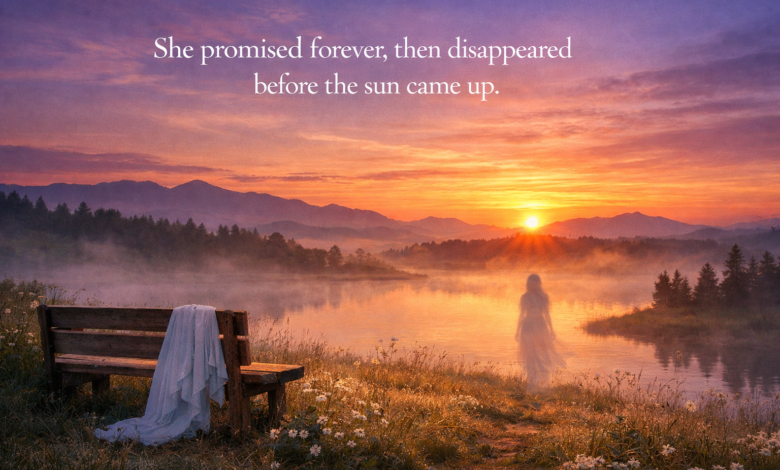
I woke to the quiet first—the kind that doesn’t belong to early morning but to abandonment. The room still smelled like her shampoo, citrus and rain, and the left side of the bed was cold, sheets pulled tight as if no one had slept there at all. For one stupid, floating second, I thought I’d imagined her. That I’d dreamed the way her fingers traced promises into my back, the way she said my name like it was something worth keeping.
Then I saw the note.


It wasn’t long. She never liked wasting words.
I meant what I said. I just can’t stay.
No signature. No goodbye. Like if she wrote my name, she might unravel.
I folded the paper until the creases cut my fingers.
Lena had come into my life like a reckoning—uninvited, inevitable. We met in the city library, both reaching for the same battered copy of a book neither of us intended to read. She smiled like she already knew me, like she’d been waiting.
“You keep choosing endings,” she said later, when we sat on the floor between the shelves. “Why?”
I shrugged. “Endings feel honest.”
She shook her head. “Endings are just fear with better marketing.”
I should have recognized the warning then. Lena always spoke like someone running out of time.
For three months, she stayed. Three months of coffee at dawn and midnight walks and whispered plans we both pretended weren’t fragile. She said forever the way some people say tomorrow—casually, carelessly, as if it would simply arrive.
Until it didn’t.
The past didn’t come back all at once. It never does. It waits until you think you’ve outgrown it, then taps you on the shoulder.
A week after Lena left, my mother called. We hadn’t spoken in years—not since I stopped asking questions she refused to answer.
“I found your father’s journals,” she said. Her voice trembled like a loose thread. “I think you should read them.”
I almost said no. I almost chose another ending.
But something in me was tired of running.
The journals were old, leather-bound, edges softened by time. I opened one at random.
I left before dawn because if I stayed until the light, I would have broken.
My breath caught.
The words blurred as memory rose—my father’s empty side of the bed, my mother’s silence stretched thin and sharp. I was seven when he disappeared. One night he promised we’d go to the ocean. By morning, his shoes were gone.
I’d spent my life believing he didn’t love us enough to stay.
The journals told a different story.
He wrote about fear—of failing, of hurting us, of becoming his own father. He wrote about promises that felt heavier than chains, about loving us so much it scared him into leaving.
I slammed the book shut, hands shaking.
Lena’s words echoed in my head: Endings are just fear with better marketing.
That night, I dreamed of dawn.
I saw my father standing in a doorway, light bleeding around him, his face split between longing and terror. I saw Lena behind him, her hand hovering over the knob, eyes full of apology.
When I woke, the truth sat heavy in my chest.
I didn’t fall in love with Lena by accident.
I recognized her.
I went back through our conversations, hunting for what I’d missed. The way she flinched at the word always. The way she never unpacked her bag. The scar on her wrist she never explained.
And me—God, me—how I kept one foot out the door, how I never asked her to stay because part of me expected her to leave. I’d built my life around absence, convinced myself it was safer to be the one left than the one who needed.
The past hadn’t just shaped me.
I’d been reenacting it.
I found Lena two weeks later, sitting in a diner on the edge of town, staring into a mug she wasn’t drinking from. She looked smaller somehow, like someone who’d been holding her breath too long.
She didn’t seem surprised to see me.
“I wondered when you’d find me,” she said.
“Why?” I asked. Not why did you leave—that felt too small now. “Why promise forever if you were going to run?”
She swallowed. “Because I wanted to believe I could stay.”
I told her about the journals. About my father. About the way disappearing before the sun came up had carved a hollow into my life.
She listened, eyes shining.
“I do that,” she whispered. “I leave first. If I don’t, I feel like I’ll vanish anyway.”
We sat in silence, two people staring at the same wound from opposite sides.
“I’m not asking you to promise forever,” I said finally. My voice shook, but I didn’t stop. “I’m asking you to stay until the light. Even if it’s hard. Even if you’re scared.”
She looked at me like the choice terrified her.
“I don’t know how,” she said.
I reached across the table. “Neither do I. But I’m done waking up alone and pretending it’s fate.”
Lena didn’t come back with me that day.
But she didn’t disappear either.
She stayed for coffee. For sunset. For the slow, fragile truth of being seen.
And when morning came, the sun rose over us both—tired, afraid, still there.
I don’t know what forever looks like. I’ve stopped trying to trap it in promises.
What I know is this: the past only owns you if you refuse to face it. And when you finally do, you get to choose something braver than running.
You get to choose to stay.
Also Read: The Shadow of Beauty A Story of Identity & Self-Discovery