The letter arrived on a Tuesday, thin as a breath and just as fragile.
I almost threw it away.


It had my name written in a handwriting I hadn’t seen in twelve years—slanted slightly to the right, careful but never stiff. The sight of it made my chest tighten in a way I hadn’t felt since I learned how to survive without answers. I stood in my kitchen, the kettle screaming itself into steam, and held the envelope like it might dissolve if I touched it too firmly.
I knew who it was from before I opened it.
Some loves don’t fade. They don’t stay, either. They wait—quietly, patiently—until you’re no longer prepared to meet them.
I met Eli when I was nineteen and convinced that love was something you could earn by being good enough. We were both broken in ways we hadn’t learned to name yet. He had laughter that filled rooms and sadness that only came out at night. I had ambition sharp enough to cut myself on, and a past I never spoke about.
We loved each other recklessly, the way people do when they think time is endless.
But time was not endless. It was cruelly precise.
I left town after my mother died, carrying her secrets like a second spine. I told Eli it was for work, for opportunity, for growth. That was true—but not all of it. The rest stayed lodged in my throat, unspoken and heavy.
I never told him I was afraid.
Afraid that if he knew the truth about me—about the night that fractured my family, about the silence I had learned to wear like armor—he would look at me differently. Or worse, stay out of pity.
So I chose absence instead.
He didn’t stop me. That hurt almost as much as leaving.
The letter was short.
I’m back in town. I don’t know if you’ll want to see me, but there’s something you deserve to know. I should have told you a long time ago.
I read it three times, my hands shaking more each time. The past I had buried so carefully had found me anyway. It always does.
I didn’t sleep that night. I lay awake with memories pressing against my ribs—Eli’s hand in mine, the way he said my name like it mattered, the moment I walked away without looking back.
By morning, I knew I couldn’t run again. Not if I wanted a future that wasn’t built on unfinished sentences.
We met at the old train station café, the one that smelled like burnt coffee and endings. He looked older. So did I. Time had softened his edges and sharpened mine.
For a moment, we just stared at each other, two people carrying different versions of the same grief.
“I loved you,” he said quietly, as if stating a fact rather than a confession.
“I know,” I replied. “I loved you too.”
That was the tragedy of it. Love had never been the problem.
He told me then—about the night before I left, when he’d gone to my mother’s house to surprise me. About the argument he overheard through the door. About the truth I didn’t know he knew.
“I waited for you to tell me,” he said. “I thought if I stayed long enough, you’d trust me.”
I felt something inside me break open. Not pain—release.
All those years, I had carried my past alone, believing it made me unlovable. Believing leaving was kindness. But love isn’t protected by silence. It’s destroyed by it.
“I was scared,” I said, finally giving the fear a voice. “I thought my past would ruin us.”
Eli shook his head gently. “It didn’t ruin us. Not knowing did.”
We didn’t end up together.
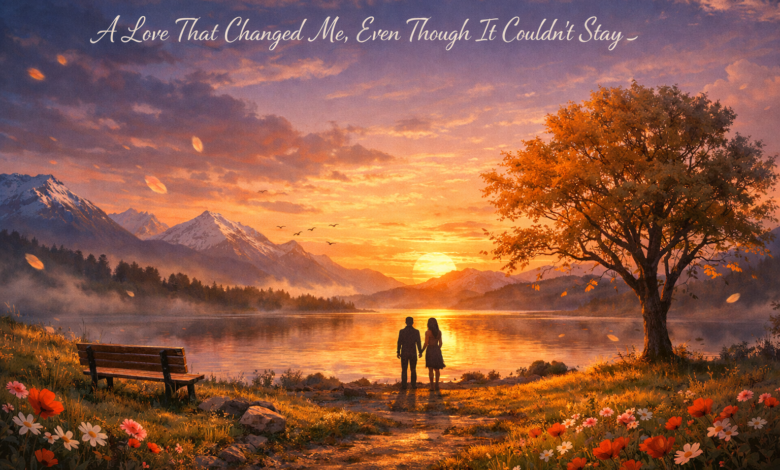
Some loves aren’t meant to last forever. They’re meant to change you so you can become someone who no longer runs from truth.
When we said goodbye, it didn’t feel unfinished. It felt honest.
That night, I went home and did something I’d never done before—I wrote my story down. Not the polished version. The real one. The one with scars and silence and survival.
The past had shaped me, yes. But confronting it reshaped my future.
I learned that love doesn’t have to stay to matter.
Some love comes into your life to teach you how to stop hiding.
And once you learn that lesson, you finally know how to stay—with yourself.
See More: The Door In Amsterdam That Changed My Life