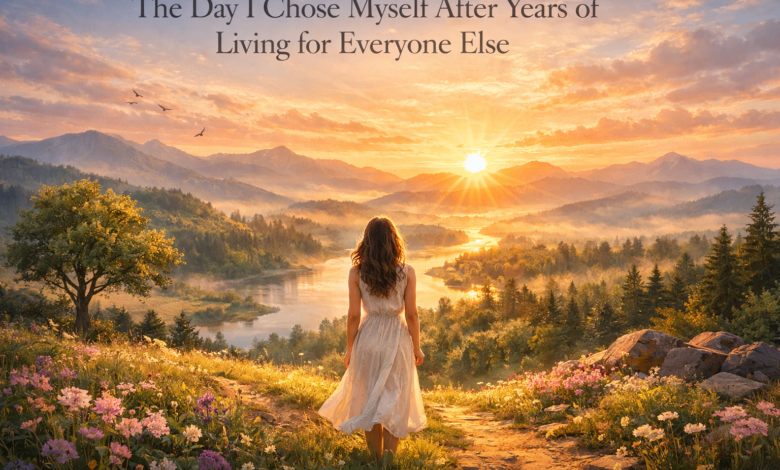
I learned how to disappear early.
Not in the dramatic sense—no smoke, no slammed doors—but in the quiet, practiced way of making myself useful. Agreeable. Small enough to fit wherever I was needed. I became the listener, the fixer, the dependable one. The daughter who didn’t complain. The friend who stayed up late. The partner who bent without breaking, even when something inside me quietly splintered.


People praised me for it.
“You’re so strong.”
“You’re so selfless.”
No one ever asked what it cost.
The day I chose myself began like every other day I had lived for everyone else—until the past knocked on my door and refused to be ignored.
It arrived in the form of a cardboard box.
My mother had called that morning, her voice careful, rehearsed. “I found some of your things in the attic. Old notebooks. I thought you might want them.”
I didn’t. Or at least, I told myself I didn’t. But that afternoon, the box sat on my kitchen floor, its edges softened by time, its weight heavier than it should have been.
Inside were pieces of a person I barely remembered: school papers, photos, and at the bottom, a notebook with a cracked blue cover.
My handwriting stared back at me—round, hopeful, unafraid.
I opened it.
The first page wasn’t a poem or a plan. It was a confession.
I don’t think I’m allowed to want things.
My chest tightened. I had no memory of writing that, yet every word felt familiar, like a scar I’d forgotten how I got.
Page after page, the truth unfolded. I had wanted to be an artist once. I had wanted to leave home. I had wanted to say no. And then—there it was, the memory I had buried so deeply it felt like fiction.
I had tried to choose myself before.
I was seventeen. I had been accepted into a program in another city—something creative, something that made my heart race. I remembered standing in the kitchen, acceptance letter trembling in my hands, my voice shaking as I told my parents.
My mother had smiled, but it didn’t reach her eyes. My father had sighed, tired before the conversation even began.
“That’s not practical,” he said.
“You’re needed here,” she added.
“Don’t be selfish.”
I remembered folding the letter. Not tearing it. Just folding it carefully, as if that made the surrender gentler.
The notebook ended abruptly after that. No more dreams. No more wants. Just lists. Responsibilities. Other people’s needs.
I sat on my kitchen floor, thirty-two years old, and finally understood something that broke me open:
I hadn’t lost myself.
I had given myself away.
Every choice since then had been shaped by that moment—every compromise, every silence, every time I told myself this is just how life is. I had been living a future designed to protect everyone else from discomfort, disappointment, or change.
Except me.
The grief came fast and ruthless. I cried for the girl who learned that love was conditional. For the woman who thought exhaustion was a virtue. For the years spent waiting for permission that was never coming.
And then something else rose beneath the grief—anger. Not sharp, not destructive. Clean. Clarifying.
That night, I did something unfamiliar.
I listened to myself.
I didn’t ask if it was reasonable or convenient or fair to anyone else. I asked one question only: What do I want?
The answer scared me. It still does.
But the next morning, I made the call I had been avoiding for months. I said no where I had always said yes. I set boundaries that felt clumsy and necessary. I signed up for a class I didn’t need to justify. I chose uncertainty over quiet resentment.
People were confused. Some were hurt. Some didn’t understand the change.
But for the first time, I did.
The past didn’t return to punish me—it returned to remind me. To show me the moment I had learned to abandon myself, so I could finally choose differently.
I still care deeply. I still love fiercely. But I no longer disappear to earn my place in the world.
The day I chose myself wasn’t loud. There were no witnesses. Just a woman on a kitchen floor, holding a broken blue notebook, deciding that her life would no longer be an apology.
And that decision—terrifying, imperfect, and long overdue—changed everything.
See More: A Wedding Day Truth That Changed Everything