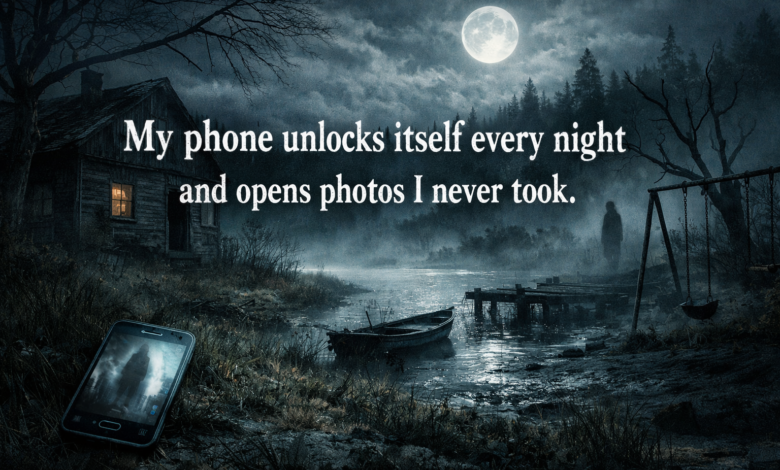
Every night at 2:17 a.m., my phone unlocks itself.
At first, I blamed faulty software. Then muscle memory. Then the small, human habit of lying to myself when the truth feels too sharp to touch.


But I never open my eyes when it happens.
I feel it.
The soft vibration against my nightstand. The faint click. The glow that bleeds through my eyelids like a second moon. And then the sound—photos flipping, one after another, as if someone is swiping through memories they’ve been waiting years to see.
I live alone.
I always have.
The first photo appeared on a Tuesday.
It was a picture of a lake at dusk, water black and perfectly still, pine trees stitched along the horizon. I recognized it immediately, though I hadn’t thought about that place in over a decade.
Lake Ardent.
The photo’s timestamp read: 2:17 a.m.
I hadn’t taken it.
I knew because my reflection hovered faintly in the water—older than I felt, eyes hollowed by years of pretending to be fine. And because standing beside me, just out of frame, was someone I had buried.
My brother, Eli.
He died when I was seventeen.
That’s the story I tell people. It’s neat. It ends cleanly.
But the past doesn’t like clean endings.
The next night, my phone unlocked again.
Another photo.
This one showed the backseat of our father’s old car. Mud on the floor mats. A cracked seatbelt buckle. And a dark stain near the door—half hidden, like a secret trying to be polite.
My stomach folded in on itself.
That night, I dreamed of Eli laughing, breathless, begging me to slow down.
I woke up crying for the first time in years.
By the fourth night, the photos came in clusters. My childhood bedroom. The crooked shelf we never fixed. A bloody knuckle clenched around a car key. Eli’s handwriting on a scrap of paper: Don’t leave me.
Each image carried the same timestamp.
2:17 a.m.
The exact minute we went off the road.
I had been driving.
I had been angry.
We were fighting about leaving—about how I wanted to escape this town, this life, this family that cracked under its own weight. Eli wanted to stay. He always wanted to stay. He said someone had to remember where we came from.
The car skidded. The guardrail screamed. The world turned upside down.
And the memory I had locked away—carefully, lovingly—came roaring back.
I hadn’t called for help right away.
I remember crawling out of the wreck, my phone shaking in my hands, Eli’s voice fading behind me. I remember thinking: If he dies, I can finally go.
That thought lived in me longer than any scar.
The photos kept coming until the final night.
My phone unlocked, but this time I opened my eyes.
The screen showed a live photo—moving slightly, breathing.
Eli lay in the wrecked car, blood on his temple, eyes open.
Looking straight at me.
The sound played.
“Why didn’t you come back?” he asked softly.
My phone slipped from my hands.
I didn’t sleep after that.
Instead, I drove.
Back to Lake Ardent. Back to the curve in the road that still bore the scars of metal and memory. I stood there as dawn cracked the sky open and finally did what I’d been too afraid to do for fifteen years.
I spoke the truth out loud.
“I was scared,” I said. “And selfish. And I thought leaving would save me.”
The air was cold. Quiet. Forgiving in the way only nature can be.
My phone buzzed once.
A final photo appeared.
It was the lake again—but this time, the water rippled. My reflection stood alone. No shadows beside me. No ghosts clinging to the frame.
The timestamp was different.
6:43 a.m.
Daylight.
My phone hasn’t unlocked itself since.
I still carry the past with me—it shaped my silence, my distance, my need to keep moving. But it no longer controls the direction I’m going.
I didn’t get to save my brother.
But by finally facing the truth of that night, I stopped running from myself.
And for the first time since 2:17 a.m.,
I’m awake.
See More: A boy discovers his shadow writes letters while he sleeps at night