The elevator had never done this before.
I’d ridden it every weekday for seven years—sixteen floors up, sixteen floors down, the same soft chime, the same flickering fluorescent lights. I could have pressed the buttons with my eyes closed. In fact, I often did, half-asleep, coffee in hand, mind already drifting toward meetings and deadlines.


That morning, I pressed 16.
The doors slid shut. The elevator began to rise.
It passed 3.
5.
8.
Then it slowed.
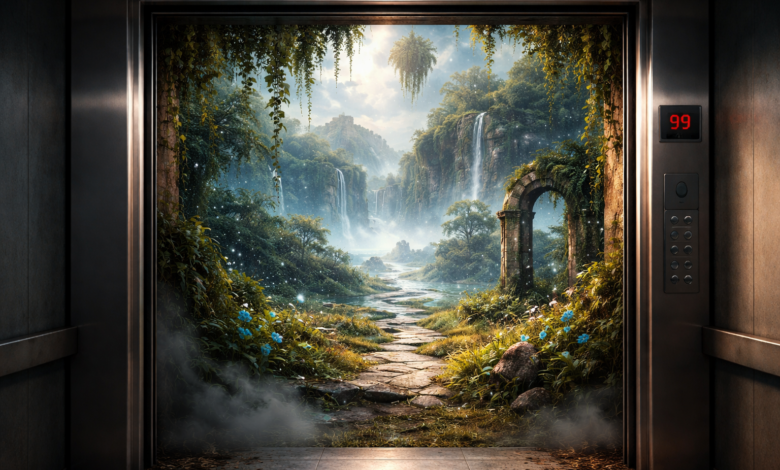
The digital display blinked once, twice… and settled on 13.
There was no thirteenth floor in this building.
A dull clang echoed through the shaft, and the elevator came to a complete stop.
My first instinct was irritation. Late again, I thought. I jabbed the “Door Open” button. Nothing happened. The air felt heavier, warmer, as if the elevator had inhaled and was holding its breath.
Then the doors opened.
The hallway beyond was dim and narrow, carpeted in a deep blue I hadn’t seen in years. The walls were lined with framed photographs—school portraits, birthday snapshots, blurry candids taken when no one was looking.
My photographs.
My stomach tightened.
I stepped out before I could stop myself.
The elevator doors slid shut behind me with a soft, final thud.
The hallway smelled like old books and rain. At the far end stood a single door, slightly ajar. A warm, yellow light spilled through the crack, and with it came a sound I hadn’t heard since I was seventeen.
My mother’s voice.
I froze.
She had died twelve years ago. A sudden stroke. No warnings. No goodbyes. Just a phone call in the middle of the night and a lifetime split cleanly in two.
I had never gone back to the house after the funeral. Never sorted through her things. Never listened to the last voicemail she left me. I told myself I was protecting my future by leaving the past where it belonged.
The door creaked open as if inviting me in.
Inside was our old kitchen, impossibly intact. The chipped wooden table. The calendar still turned to March. Sunlight filtered through the window in the exact slant I remembered from that final morning.
My mother stood at the counter, back to me, stirring a pot that sent up curls of steam.
“You’re going to be late,” she said gently, without turning around.
My chest ached. “I know,” I whispered.
She finally faced me. She looked younger than I remembered—less tired, less fragile. Alive in a way memory rarely allows.
“You didn’t leave a note,” she said.
The words struck harder than I expected.
“I was angry,” I said. “I thought if I stayed, I’d become… stuck. Like you. Like this place.”
She smiled sadly. “You thought leaving would erase everything.”
“I thought it would make it easier.”
She reached into her pocket and pulled out a folded piece of paper. My handwriting stared back at me.
A letter I never sent.
In it, I had confessed everything: my fear of becoming small, my resentment of her sacrifices, my guilt for wanting more than this town, this life. I had written it the night before I left, then tore it up and threw it away.
Or so I thought.
“You didn’t forget,” I said.
“I didn’t need the letter,” she replied. “I already knew.”
Tears blurred my vision. For years, I had carried the weight of unspoken words, convinced they had shaped me into someone colder, sharper—someone who ran at the first sign of pain.
“Why now?” I asked. “Why bring me here?”
She glanced toward the door, where the elevator bell chimed softly, impatient.
“Because you’ve been living as if the past is something you can outrun,” she said. “And because you’ve built your future on silence.”
The kitchen began to fade, the walls dissolving into light.
“Staying doesn’t mean failing,” she added. “And leaving doesn’t mean forgetting. But you have to choose what you carry with you.”
The elevator chimed again.
When I stepped back inside, the doors closed gently, almost kindly. The elevator descended without a sound, the numbers ticking down until it stopped at 16.
The doors opened to the familiar office hallway—bright, modern, ordinary.
But I wasn’t the same.
That afternoon, I finally listened to the voicemail. That evening, I booked a train ticket home. Not to stay forever, not to undo the past—but to face it, to sort through the memories I’d abandoned, to speak the words I’d swallowed for too long.
The elevator never stopped at the thirteenth floor again.
But sometimes, when I’m riding alone, I swear I can hear my mother’s voice beneath the hum of the cables—reminding me that who I was is not a ghost to fear, but a truth to understand.
And that facing it doesn’t trap you.
It sets you free.
See More: Stop Dreaming 5 Reasons Altcoin Season May Never Come