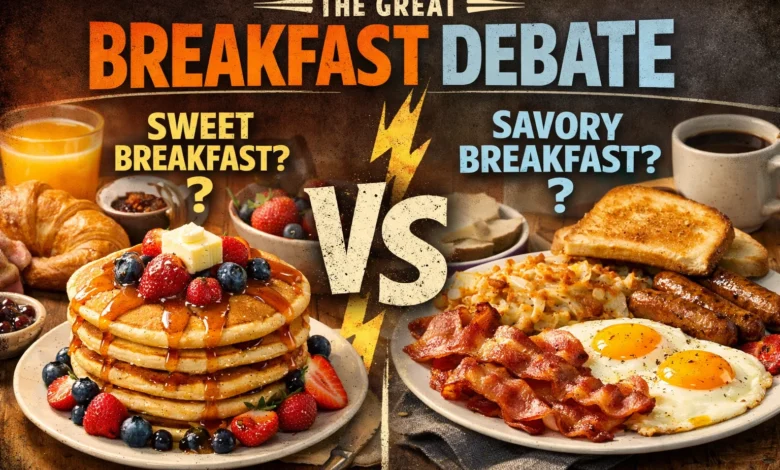
The Mitchell household had survived many conflicts over the years. They’d weathered disagreements about politics, religion, and even the proper way to load a dishwasher. But nothing, absolutely nothing, compared to the great breakfast debate that had divided their family for three generations.
It started, as most family legends do, with Grandpa Ernest and Grandma Rose. Ernest believed that breakfast should be a hearty, protein-packed affair: eggs, bacon, sausage, hash browns, and toast slathered in butter. Rose, on the other hand, championed the virtues of a lighter morning meal—fresh fruit, yogurt, granola, and perhaps a croissant if one felt particularly indulgent. Their marriage had lasted fifty-two years, but they never once agreed on breakfast.
Now, in the cozy kitchen of the Mitchell family home, their legacy lived on through their children and grandchildren, and the great breakfast debate had reached legendary proportions.
“Pancakes are objectively superior to waffles,” declared Marcus Mitchell, age forty-two, as he stood at the stove on a Saturday morning. “They’re fluffy, they absorb syrup better, and they don’t require a specialized appliance.”
His sister, Diana, rolled her eyes so dramatically that her teenage daughter, Sophie, laughed into her orange juice. “That’s exactly your problem, Marcus. You think breakfast should be simple and utilitarian. Waffles are an experience. Those little pockets hold the syrup, the butter, the fruit. They’re architectural marvels.”
“They’re pretentious,” Marcus shot back, flipping a pancake with unnecessary force.
Their mother, Patricia, sighed from her position at the kitchen table where she was carefully arranging sliced avocado on whole-grain toast. “You two are both wrong. Neither pancakes nor waffles provide the sustained energy you need for the day. Now, avocado toast with a poached egg—”
“Oh, here we go,” Marcus and Diana said in unison.
The great breakfast debate had intensified when Marcus’s wife, Jennifer, joined the family five years ago. A former chef, Jennifer had strong opinions about morning cuisine that she wasn’t afraid to share. She entered the kitchen now, took one look at Marcus’s pancakes, and wrinkled her nose.
“Are you seriously using boxed mix?” she asked, her tone suggesting he’d committed a cardinal sin.
“It’s convenient,” Marcus defended himself.
“It’s an abomination,” Jennifer countered, already pulling out flour, eggs, and buttermilk. “If you’re going to participate in the great breakfast debate, at least bring your A-game. Breakfast is the most important meal of the day—why would you phone it in with processed ingredients?”
Sophie, who had been quietly observing the chaos while scrolling through her phone, suddenly looked up. “Actually, the whole ‘breakfast is the most important meal of the day’ thing was created by cereal companies for marketing. I read about it in my nutrition class.”
The kitchen fell silent. Four pairs of eyes turned to the sixteen-year-old.
“What did you just say?” Patricia asked slowly.
“It’s true,” Sophie continued, warming to her subject. “There’s no real scientific evidence that breakfast is more important than any other meal. In fact, some people do better with intermittent fasting. I’ve been skipping breakfast for a month, and I feel great.”
The explosion was immediate and cacophonous. Marcus dropped his spatula. Jennifer looked personally offended. Diana gasped as if Sophie had announced she was joining a cult. Patricia clutched her avocado toast like a life preserver.
“Skipping breakfast?” Marcus finally managed. “Sophie, that’s—that’s not healthy.”
“It’s a perfectly valid dietary choice, Dad,” Sophie replied calmly. “Not everyone needs to eat in the morning. Maybe the great breakfast debate is really about respecting different approaches to nutrition.”
This revolutionary statement should have brought peace to the Mitchell kitchen. Instead, it only expanded the great breakfast debate into new, uncharted territory. Now they weren’t just arguing about what to eat for breakfast—they were arguing about whether to eat breakfast at all.
Grandma Rose, who had been living with Patricia for the past two years, shuffled into the kitchen in her bathrobe. At eighty-seven, she’d seen enough family drama to fill several lifetimes, but the great breakfast debate still managed to amuse her.
“You’re all ridiculous,” she announced, heading straight for the coffee pot. “In my day, you ate what was put in front of you and were grateful for it.”
“In your day, you also fought with Grandpa about breakfast every single morning,” Diana pointed out.
Rose’s eyes twinkled. “True. But at least Ernest and I knew what we were fighting about. You people have turned it into an Olympic sport.”
She settled into her chair with her coffee and a simple piece of buttered toast—her breakfast of choice for seven decades. “Let me tell you something about the great breakfast debate in this family. It’s not really about the food.”
Everyone turned to look at her.
“When your grandfather insisted on his big breakfasts, it was because his mother used to make them for him before he went to work with his father. It reminded him of feeling loved and prepared for the day. When I wanted my fruit and yogurt, it was because I was trying to stay healthy enough to keep up with you kids.” She gestured around the table. “Diana with your waffles—you’re trying to create special moments. Marcus with your pancakes—you want breakfast to be warm and uncomplicated like your childhood. Jennifer, you show love through perfecting recipes. Patricia, you’re trying to give everyone the best chance at a healthy day. And Sophie, sweetheart, you’re asserting your independence.”
The kitchen was quiet except for the coffee pot’s gentle gurgle.
“The great breakfast debate isn’t about winning,” Rose continued. “It’s about understanding that we all have different needs, different histories, different ways of showing we care. Ernest and I argued about breakfast for fifty-two years, but we always sat down and ate together. That was what mattered.”
Jennifer was the first to speak. “So you’re saying we should all just make what we want and stop judging each other?”
“I’m saying the debate is fine—it’s actually kind of fun,” Rose said with a smile. “But remember it’s just breakfast. The real point is that we’re all here, together, arguing about it.”
Marcus looked at his boxed-mix pancakes with new eyes. “I guess these aren’t that terrible.”
“They’re still terrible,” Jennifer said, but she was smiling. “But they’re your terrible pancakes, and you make them with love, so that counts for something.”
Diana raised her orange juice. “To the great breakfast debate—may it never be resolved.”
“Hear, hear,” Patricia agreed, and they all clinked glasses and mugs.
Sophie grinned. “Does this mean I can still skip breakfast?”
“Absolutely not,” came the chorus of replies, and the debate began anew.
But something had shifted. As Marcus made his pancakes and Jennifer started her from-scratch batter, as Diana prepped the waffle iron and Patricia assembled her avocado toast, as Sophie grudgingly poured herself some cereal and Rose buttered her simple toast, the kitchen filled not with conflict but with laughter.
The great breakfast debate continued at the Mitchell house every morning after that. Marcus still championed his boxed-mix pancakes (though he occasionally let Jennifer teach him to make them from scratch). Diana remained devoted to her waffles. Patricia evangelized about the virtues of avocado toast. Jennifer rotated through elaborate breakfast creations—shakshuka, Dutch babies, breakfast burritos that required three pans and a dozen ingredients. Sophie experimented with smoothie bowls and overnight oats, compromise foods that technically counted as breakfast but could be consumed quickly.
And through it all, Grandma Rose sat with her buttered toast and coffee, watching her family carry on the tradition she and Ernest had started so many years ago.
The great breakfast debate had taught them something valuable: that families don’t need to agree on everything to love each other. That traditions can be both sacred and silly. That sometimes the arguing is just another way of being together, of caring enough to engage, of showing up every morning and choosing, once again, to be a family.
Because in the end, it didn’t matter whether breakfast was pancakes or waffles, elaborate or simple, early or late, or even existed at all. What mattered was the people gathered around the table, ready to debate, laugh, compromise, and occasionally surrender to the wisdom of an eighty-seven-year-old woman who’d been watching the show for decades.
The great breakfast debate would never be won, and that was exactly as it should be. Some family traditions are meant to be passed down, not resolved. And every Mitchell, from the oldest to the youngest, secretly hoped that long after they were gone, some future generation would still be arguing about the merits of pancakes versus waffles, of big breakfasts versus light ones, of tradition versus innovation.
Because that would mean they’d succeeded in creating something bigger than themselves: a family that stuck together through thick and thin, through agreements and arguments, through every morning and every meal, united not despite their differences but because of them.
And really, that was the most important meal of all.
Read More: The Shadow of Beauty A Story of Identity & Self-Discovery