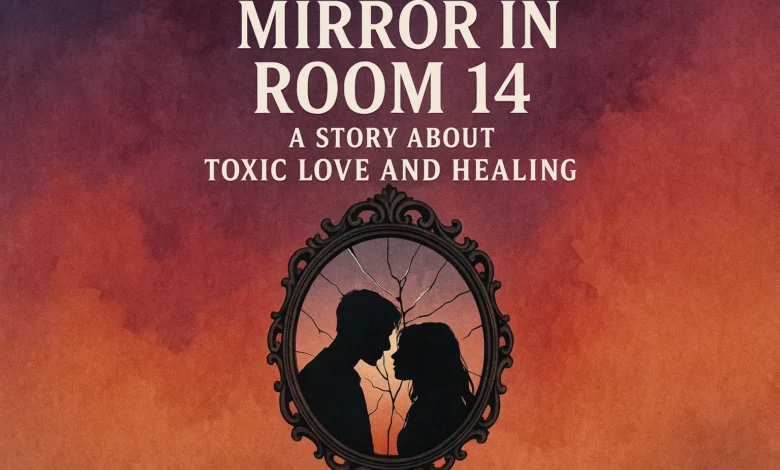
A Story About Toxic Love and Healing. Emma hadn’t been inside her childhood home in seven years. Not since the funeral. Not since she’d stood in the cemetery with Marcus’s arm tight around her waist, so tight it left bruises she’d explained away as clumsiness.
Now, at thirty-two, she stood in the empty living room where dust motes danced in afternoon light, and she could barely breathe. The estate lawyer had been insistent—the house needed to be cleared before the sale. Her brother Daniel refused to come back from Seattle, so it fell to her.


“I’ll be quick,” she’d promised Marcus that morning. “Just grabbing some papers.”
He’d smiled, but his eyes hadn’t. “Don’t talk to anyone. And keep your phone on. I’ll call to check in.”
She’d nodded. She always nodded.
Room 14
The house felt smaller than she remembered. Emma moved through it mechanically, boxing up dishes, sorting through mail from seven years ago. But she kept avoiding the second floor. Kept avoiding her mother’s bedroom—the room her mother had jokingly called “Room 14,” like they lived in a hotel instead of a house.
It was nearly dusk when Emma finally climbed the stairs.
The bedroom door stuck, swollen with humidity and disuse. When it finally gave way, Emma froze. The room was exactly as she remembered—the faded floral wallpaper, the brass bed frame, the oval mirror above the dresser.
The mirror.
A Story About Toxic Love and Healing: Emma approached it slowly. As a child, she’d watched her mother stand before this mirror every morning, covering bruises with foundation, practicing smiles. “We don’t tell people our private business,” her mother would say. “What happens in a marriage stays in a marriage.”
Emma’s hand trembled as she opened the dresser drawer.
The Evidence
Inside, wrapped in a silk scarf, was a spiral notebook. Emma recognized her mother’s handwriting on the cover: “My Truth.”
She sat on the edge of the bed and began to read.
March 12, 2009: He threw my phone against the wall today because I didn’t answer fast enough. Said I must be hiding something. I’m not. I just went to the grocery store.
June 3, 2009: He says I’m lucky anyone loves me. That I’m too fat, too stupid, too boring. Sometimes I believe him.
September 17, 2009: Emma graduates high school today. She’s wearing long sleeves even though it’s 85 degrees. I think she’s trying to hide something, but I can’t ask. I can’t even save myself. How can I save her?
Emma’s vision blurred. Her phone buzzed—Marcus calling for the fourth time that hour. She let it ring.
November 4, 2009: He controls all the money. I tried to open my own account, but he found out. He said marriage means sharing everything, that I’m selfish for wanting secrets. I feel like I’m disappearing.
The entries continued, each one a knife to Emma’s heart. Her mother had known. She’d seen everything and had been powerless to stop it. Just like Emma was now.
February 14, 2010: He bought me roses today. Apologized for last night. Said he only gets angry because he loves me so much, because he can’t stand the thought of losing me. I want to believe him. I want this to be real love. But real love shouldn’t hurt like this.
Emma’s phone buzzed again. This time, a text: “Where are you? Why aren’t you answering? Don’t make me come looking for you.”
Her chest tightened—that familiar fear, the need to explain, to apologize, to soothe his anger before it became something worse.
But she didn’t pick up the phone.
The Warning Signs She’d Ignored
Emma kept reading, and with each page, she saw her own life reflected back. The isolation—her mother cut off from friends, just like Marcus had slowly separated Emma from everyone who cared about her. “They’re just jealous of what we have,” he’d say.
The constant checking—her mother’s husband needing to know where she was every moment, just like Marcus needed Emma’s location shared on her phone, needed her to text him photos of where she was, who she was with.
The mood swings—explosive anger followed by tearful apologies and expensive gifts. “I’m sorry, baby. You know I love you. I just can’t help it when you make me worry.”
The gaslighting—”That never happened.” “You’re remembering it wrong.” “You’re too sensitive.” “You’re crazy.” Until Emma had stopped trusting her own memory, her own instincts.
The control—what she wore, what she ate, who she talked to, how she spent every minute of her day.
On the last page, dated just weeks before her mother died, was a letter:
My dearest Emma,
If you’re reading this, I’m gone. I’m writing this because I need you to know something, even though I was too weak to tell you while I was alive.
I stayed for all the wrong reasons. I stayed because I thought love was supposed to be hard. I stayed because he said no one else would want me. I stayed because leaving seemed scarier than staying. I stayed because I confused control with care, jealousy with love.
I watched you grow up in this house, absorbing these lessons like poison. I watched you choose a man just like your father, and I said nothing. I was too ashamed. Too afraid. Too broken.
But I need you to know: this isn’t love. Love doesn’t leave bruises. Love doesn’t make you small. Love doesn’t require you to disappear.
You deserve better than this. Better than I had. Better than what I showed you.
It’s not too late for you, sweetheart. It’s not too late to leave. It’s not too late to save yourself.
Please, save yourself.
All my love, Mom
Breaking the Pattern
Emma sat in the dying light, the notebook clutched to her chest, and let herself cry for the first time in years. Cried for her mother. Cried for herself. Cried for all the years she’d spent telling herself that Marcus’s behavior was normal, was love, was just his way of showing he cared.
Her phone buzzed again. Then again. Six missed calls. Eleven texts, each one escalating from concern to anger to threats.
Emma looked at herself in the oval mirror—the same mirror where her mother had hidden her truth under layers of makeup and forced smiles. She saw herself clearly for the first time in years. Saw the exhaustion in her eyes, the tension in her shoulders, the way she’d learned to make herself smaller, quieter, less.
She thought about all the warning signs she’d ignored:
- The way Marcus had rushed their relationship, saying “I love you” after two weeks, moving in after two months
- How he’d isolated her from friends, calling them “bad influences”
- The way he checked her phone, her email, her social media accounts
- How he blamed her for his anger: “You made me do this”
- The apology cycle that always ended with her forgiving him
- How she’d started walking on eggshells, monitoring his moods, trying to prevent his explosions
- The feeling of being constantly watched, monitored, controlled
She thought about what her friend Sarah had said before Marcus had forbidden her from seeing Sarah anymore: “Love shouldn’t feel like a prison.”
Emma picked up her phone. Instead of calling Marcus back, she opened a new browser and searched: “domestic violence resources near me.”
The First Step
The National Domestic Violence Hotline answered on the second ring.
“I need help,” Emma whispered into the phone, her voice shaking. “I need to leave, but I don’t know how.”
The woman on the other end was kind, patient, practical. She didn’t judge. She didn’t ask why Emma had stayed. She just helped her make a plan.
By the time Emma hung up, she had a list: a safe place to stay, legal resources, a plan for getting her important documents, a safety strategy for leaving.
She took one last look around Room 14. Her mother hadn’t been able to escape, but she’d left Emma the truth. The warning. The permission to save herself.
Emma picked up the notebook, tucked it into her bag along with her mother’s letter. Then she walked out of that house and didn’t look back.
Six Months Later
Emma sat in a small apartment she’d rented under her own name, with her own money from a job Marcus didn’t control. The walls were bare, the furniture was secondhand, and it was the most beautiful place she’d ever lived.
She’d pressed charges. Filed for a restraining order. Started therapy. Reconnected with friends who’d been waiting for her with open arms. Learned to recognize the warning signs she’d missed, the patterns she’d been taught to accept.
It hadn’t been easy. Marcus had raged, pleaded, promised to change. He’d sent flowers, shown up at her workplace, called her family. He’d tried every manipulation tactic in the book.
But Emma had her mother’s notebook. She had the truth written in black and white. She had proof that this wasn’t love and had never been love.
On her kitchen table sat a framed photo of her mother, young and smiling, taken before Room 14, before the mirror, before she’d learned to hide her truth.
“I saved myself,” Emma whispered to the photo. “Just like you asked.”
And for the first time in seven years, she felt free.
Understanding Toxic Relationship Warning Signs
If you recognized yourself in Emma’s story, you’re not alone. Toxic and abusive relationships follow predictable patterns. Here are the warning signs:
Early Warning Signs:
- Love bombing: Overwhelming you with attention, gifts, and declarations of love very early
- Moving too fast: Pushing for commitment, moving in, or saying “I love you” within weeks
- Isolation: Gradually separating you from friends, family, and support systems
- Constant contact: Needing to know where you are and who you’re with at all times
Escalating Signs:
- Controlling behavior: Dictating what you wear, who you see, how you spend money
- Jealousy disguised as love: Excessive jealousy presented as caring
- Monitoring: Checking your phone, email, social media, or tracking your location
- Mood swings: Unpredictable reactions that keep you walking on eggshells
Serious Red Flags:
- Gaslighting: Making you doubt your memory, perception, or sanity
- Blame shifting: Making you responsible for their behavior or emotions
- Physical violence: Any form of physical aggression or intimidation
- Threats: Threatening harm to you, themselves, your pets, or your reputation
- Financial control: Controlling all finances or preventing you from working
The Cycle of Abuse:
- Tension building: Walking on eggshells, trying to prevent an outburst
- Incident: Emotional, verbal, or physical abuse occurs
- Reconciliation: Apologies, promises to change, gifts, affection
- Calm: Brief period of peace before the cycle repeats
Resources for Help
If you or someone you know is experiencing abuse:
National Domestic Violence Hotline: 1-800-799-7233 (Available 24/7) Crisis Text Line: Text START to 88788 Website: thehotline.org
Remember: Leaving is the most dangerous time. Create a safety plan with professional help. You deserve love that doesn’t hurt. You deserve to feel safe. You deserve to be free.
Read More: Top AI Avatar Creators 2025 Best Tools Reviewed & Compared