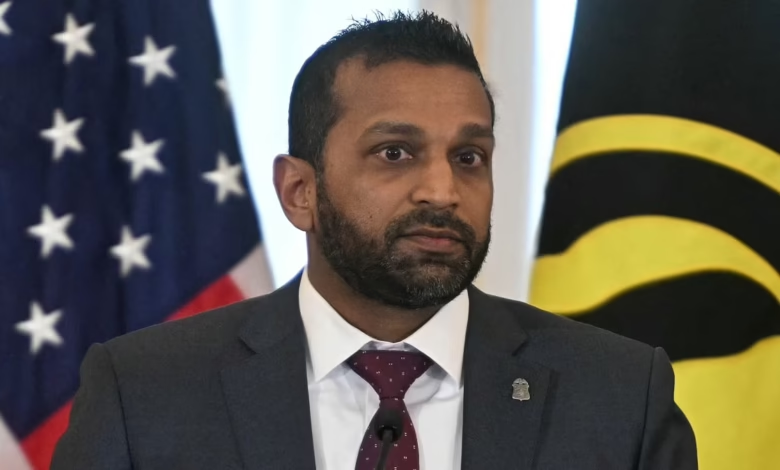
Kash Patel serves as the ninth director of the Federal Bureau of Investigation since February 2025, making him one of the most talked-about figures in American law enforcement today. Born Kashyap Pramod Patel on February 25, 1980, in Garden City, New York, this Indian-American lawyer has rapidly ascended from public defender to the head of the nation’s premier investigative agency.
The appointment of Kash Patel as FBI director represents a significant shift in how the bureau operates and engages with political leadership. His confirmation came amid intense debate about his qualifications, loyalty to former President Donald Trump, and his vision for reforming federal law enforcement agencies.


Understanding Kash Patel’s background, career trajectory, and current role provides essential context for anyone following American politics, national security, or law enforcement developments in 2025.
Early Life and Educational Background
Roots and Family Heritage
Kash Patel’s father, Pramod Patel, was of Ugandan-Gujarati Indian descent and was among those expelled by dictator Idi Amin in 1972. The Patel family’s journey from persecution in Uganda to eventual settlement in the United States shaped much of Kash’s perspective on American opportunity and justice.
The family originally hailed from the village of Bhadran in Gujarat’s Anand district, where their genealogy has been maintained for 18 generations. After facing ethnic persecution, they briefly returned to India while seeking asylum in multiple countries before ultimately settling in Canada, then moving to the United States where Pramod became a chief financial officer for an aircraft bearings distributor.
Academic Journey
Kash Patel’s educational path reflected his early interest in law and justice:
He studied criminal justice and history at the University of Richmond, graduating in 2002. This undergraduate foundation would prove instrumental in his later career as a public defender and federal prosecutor.
Patel earned his law degree from Pace University School of Law in 2005, also obtaining a certificate in international law from University College London. His legal education equipped him with the tools to navigate complex federal cases and national security matters.
Career Before the FBI
Starting as a Public Defender
In 2005, Patel began working as a public defender in Miami-Dade County, Florida, representing individuals who couldn’t afford private attorneys. This experience gave him frontline exposure to the American justice system’s challenges and inequities.
Colleagues from this period recall Patel as effective in courtroom interactions and building rapport with judges, though some noted he showed less interest in the extensive paperwork that accompanied public defense work. Patel tried scores of jury trials in federal and state courts, handling cases ranging from murder to narcotics trafficking and complex financial crimes.
Department of Justice Prosecutor
Patel joined the Department of Justice in 2014 as a national security prosecutor under the Obama Administration, where he led investigations spanning multiple theaters of conflict and oversaw prosecutions of al-Qaida, ISIS, and other terrorist actors.
This role positioned him at the intersection of intelligence and law enforcement, a skillset that would become central to his later appointments in the Trump administration. His work focused on counterterrorism operations and required coordination across multiple government agencies.
House Intelligence Committee Work
Patel left the DOJ in 2017 to become a senior aide to Devin Nunes, then-chairman of the House Permanent Select Committee on Intelligence. This transition marked a pivot from prosecution to congressional oversight and investigation.
As national security advisor and senior counsel for the committee, Patel spearheaded the investigation into Russia’s influence campaign during the 2016 presidential election. His work on this investigation would significantly raise his profile in conservative political circles.
The Nunes Memo
Patel was the primary author of the Nunes memo, which alleged that FBI officials abused their authority in the investigation into links between Trump associates and Russian officials. This controversial document accused the FBI and DOJ of bias against Trump and abuse of surveillance powers.
The memo focused on the FBI’s use of the Steele dossier in obtaining surveillance warrants. At the time, the FBI issued a rare public statement expressing concerns about material omissions that fundamentally impacted the memo’s accuracy. Nevertheless, the memo impressed President Trump and helped cement Patel’s reputation as a fierce administration loyalist.
Roles in the First Trump Administration
National Security Council Position
Patel’s work on the Nunes memo caught President Trump’s attention. During the first Trump Administration, Patel led the president’s counterterrorism mission as deputy assistant to the president on the National Security Council.
In this capacity, he oversaw execution of several Trump administration priorities, including operations against al-Qaida and ISIS leadership and repatriation efforts. However, some NSC colleagues reportedly found Patel to be an aggressive and difficult coworker who frequently clashed with others.
Pentagon Chief of Staff
In late 2020, Patel was appointed Chief of Staff to Acting Secretary of Defense Christopher Miller during the final months of the first Trump administration. This appointment came as part of a broader shake-up following Trump’s firing of Defense Secretary Mark Esper.
In this role, Patel helped manage Pentagon operations during a turbulent transition period, overseeing issues from troop drawdowns in the Middle East to cybersecurity readiness. His tenure, though brief, placed him at the center of U.S. defense strategy during a politically charged time.
Activities Between Administrations (2021-2024)
Media Appearances and Commentary
After Trump left office in January 2021, Patel leveraged his association with Trump to promote several business ventures and made recurring appearances on several podcasts. He became a fixture on conservative media platforms, offering commentary on national security, intelligence operations, and political accountability.
Patel hosted “Kash’s Corner” on EpochTV from 2021 to 2023 and served as a part-time guest host for Steve Bannon’s “War Room” podcast after Bannon went to federal prison in 2024. These media appearances helped him maintain visibility and build a following among Trump supporters.
The Kash Foundation
Patel founded The Kash Foundation, a 501(c)(3) charity that raises money for legal defense matters, education programs, and financial assistance for all Americans, with special emphasis on active-duty military, veterans, and law enforcement communities.
The foundation notably provided support to participants in the January 6 Capitol attack, helping them pay legal costs. This support drew criticism from those who viewed the January 6 events as an insurrection, while supporters saw it as defending political prisoners.
Trump Media Board Member
In April 2022, Patel was named to the board of Trump Media & Technology Group, further cementing his business and political relationship with the former president. This position kept him in Trump’s orbit during the years between administrations.
Children’s Books and Publishing
Patel authored several children’s books, most notably “The Plot Against the King,” which used allegory to explain the Steele dossier and investigations into Trump’s campaign. The books featured “King Donald” as the hero, with Patel portrayed as a wizard helping thwart enemies’ plans.
He also published “Government Gangsters: The Deep State, the Truth, and the Battle for Our Democracy” in 2023, which outlined his views on FBI abuses and featured a list of 60 people he identified as members of the “Executive Branch Deep State.”
Confirmation as FBI Director
The Nomination Process
In November 2024, Trump announced he would dismiss Christopher A. Wray as FBI director and nominated Patel as his replacement. Wray agreed to resign in December 2024, paving the way for Patel’s nomination despite having years remaining in his 10-year term.
The nomination sparked intense debate. Trump supporters viewed Patel as someone who would restore integrity to an agency they believed had been weaponized against conservatives. Critics worried about his lack of traditional law enforcement experience and his history of promoting conspiracy theories.
Senate Confirmation
The Republican-led Senate voted in February 2025 to confirm Kash Patel as the new FBI director despite questions about his fitness for the job. The confirmation vote was notably narrow compared to his three immediate predecessors, who each received at least 92 votes.
Republicans argued that the FBI had unfairly targeted conservatives in recent years and saw Patel as someone who would fix that purported problem. Senator Lindsey Graham stated that Patel was the right person to restore Americans’ confidence that the FBI is a law enforcement organization, not a political one.
Democrats voiced strong concerns during the confirmation process. They questioned Patel’s ability to maintain the FBI’s traditional independence from the White House and pointed to his past statements about targeting political enemies and members of the media.
Taking Office
Kash Patel became the ninth Director of the FBI on February 20, 2025. He also briefly served as acting director of the Bureau of Alcohol, Tobacco, Firearms and Explosives from February to April 2025, though he was quickly replaced by Daniel P. Driscoll.
Patel’s Vision for FBI Reform
Decentralization Plans
One of Patel’s most controversial proposals has been his vision to decentralize FBI operations. In a podcast appearance, Patel vowed to shut down FBI headquarters on Day 1 and reopen it as a “museum of the deep state”.
He has argued that keeping the FBI’s massive headquarters in Washington allows for institutional capture and incentivizes senior leadership to play political games rather than focus on their core law enforcement mission. His proposal involves dispersing FBI operations across the country to regional offices.
Priorities and Mission Focus
Speaking to reporter Catherine Herridge in November 2025, Patel highlighted the bureau’s accomplishments under his leadership, noting that in nine months they had arrested 30,000 people, including 25,000 violent felons—a double increase from the same period the previous year.
Patel also reported a 35 percent increase in counterespionage arrests and the seizure of 1,900 kilograms of fentanyl, representing a 35 percent increase from the previous year. These statistics demonstrate his focus on violent crime, counterintelligence, and drug trafficking.
Controversies and Challenges
Resource Management Concerns
Patel has drawn scrutiny for his stewardship of bureau resources, including concerns about his girlfriend’s security detail and use of government aircraft. Reports emerged analyzing flight records showing multiple trips to Las Vegas and Nashville, raising questions about whether these were appropriate uses of the FBI director’s plane.
Patel was photographed in Las Vegas at a Formula 1 race in November 2025, sitting in a pink toy Cadillac, which added to perceptions that he was using his position for personal enjoyment rather than focusing on FBI operations.
Tensions with Justice Department Leadership
Attorney General Pam Bondi has reportedly been frustrated with Patel, particularly over his untimely social media posts boasting prematurely about case breakthroughs, which sometimes threatened to jeopardize investigations.
Both Bondi and Deputy Attorney General Todd Blanche have been irritated by continuing distractions from news coverage of his questionable use of taxpayer resources. These tensions highlight the challenges of coordinating between the FBI and DOJ leadership.
New Zealand Gun Gift Incident
Patel reportedly caused a security concern in New Zealand during the summer of 2025 when he gifted inoperable 3D-printed pistols to senior security officials. The weapons, called Maverick PG22s, were toy-inspired revolvers that raised questions about diplomatic protocol and judgment.
Judge Arrest Controversy
In April 2025, Patel announced that Wisconsin circuit court judge Hannah Dugan had been arrested for allegedly misdirecting federal agents away from an undocumented immigrant. He provided a photograph of Dugan’s arrest that potentially violated internal policy against disclosing defendant photographs unless necessary or part of the public record.
Former Attorney General Eric Holder, who implemented the policy, told CNN that the post violated these guidelines. Patel quickly deleted his social media announcement, but the incident raised concerns about his understanding of Justice Department protocols.
Speculation About Job Security
In November 2025, reports emerged that President Trump was considering removing Patel as FBI director, as he and top aides had grown frustrated by unflattering headlines. Three sources familiar with the matter indicated the president was weighing whether to oust the FBI director after scrutiny of resource management issues.
However, White House Press Secretary Karoline Leavitt denied these reports, calling the story “completely made up”. She posted a photo of Trump and Patel together in the Oval Office, with both men smiling and giving thumbs up. When asked directly if he would replace Patel, Trump responded: “No! He’s doing a great job!”
Political Philosophy and Views
Deep State Allegations
Patel has been a prominent voice in promoting the concept of a “deep state”—unelected government officials he believes work to undermine elected leadership. His 2023 book “Government Gangsters” featured a list of 60 individuals he identified as deep state members, including officials from both Trump’s first administration and the Biden administration.
These views have made him popular among conservatives who believe federal agencies have become politicized against their interests, while critics argue such rhetoric undermines faith in democratic institutions and career civil servants who serve regardless of which party controls the White House.
2020 Election Claims
Patel has repeatedly promoted claims that the 2020 presidential election was stolen, despite no evidence supporting widespread fraud that would have changed the outcome. He has stated on Steve Bannon’s show that “we’re going to come after the people in the media who helped Joe Biden rig presidential elections.”
Such statements have alarmed civil liberties advocates and media freedom organizations, who worry about potential misuse of federal law enforcement powers against journalists and political opponents.
January 6 Perspectives
Patel has promoted alternative narratives about the January 6, 2021 Capitol attack. His foundation’s financial support for January 6 participants’ legal defense and his co-production of “Justice for All”—a charity record featuring Trump and a choir of incarcerated January 6 participants—demonstrate his sympathy for those prosecuted in connection with the attack.
Critics view this stance as minimizing a serious assault on democratic processes, while supporters see it as defending Americans they believe were unjustly prosecuted for political reasons.
Impact on FBI Operations
Leadership Changes
In the weeks following new Justice Department leadership, at least eight senior FBI officials were pushed out, and the department obtained a list of all FBI personnel involved in investigating the January 6 attack. This touched off fears at the bureau of possible mass firings for retaliatory reasons.
The FBI Agents Association sued to prevent making public the names of FBI employees provided to the department, citing concerns for agent safety and potential political retaliation.
Bureau Morale and Culture
Patel takes over at the FBI at a tumultuous time for the bureau. Career agents have expressed concerns about politicization of the bureau and whether investigations will be conducted based on evidence and law, or political considerations.
At the same time, FBI Agents Association President Natalie Bara congratulated Patel on his confirmation, saying they looked forward to partnering with him in the shared mission to keep America safe. This suggests at least some institutional willingness to work with the new director despite concerns.
Policy Shifts
Under Patel’s leadership, the FBI has emphasized violent crime arrests, counterespionage work, and drug seizures. However, questions remain about how the bureau will handle politically sensitive investigations, including those involving Trump associates or investigations into January 6 participants.
Patel’s past statements about targeting government officials who leak to the press and pursuing perceived political enemies have created uncertainty about whether the FBI’s traditional independence from political considerations will be maintained.
Public Perception and Media Coverage
Conservative Support
Among Trump supporters and conservative media, Patel is viewed as a reform-minded leader who will clean up what they perceive as a corrupt, politicized FBI. His willingness to challenge establishment narratives and his loyalty to Trump have made him a hero in these circles.
Conservative commentators praise his counterterrorism experience and argue that his fresh perspective is exactly what the FBI needs to restore public trust, particularly among conservatives who feel the bureau has targeted them unfairly.
Liberal and Institutional Concerns
Democratic lawmakers and civil liberties organizations have expressed deep reservations about Patel’s leadership. House member Gerry Connolly called him a “zealot” and described his nomination as “perhaps the worst” among Trump’s appointments.
Concerns center on his lack of traditional law enforcement leadership experience, his history of promoting conspiracy theories, his statements about targeting political enemies, and questions about whether he will maintain the FBI’s independence from political pressure.
Media Scrutiny
Patel has had a contentious relationship with mainstream media. He has filed (and later dismissed) multimillion-dollar defamation lawsuits against The New York Times and Politico. His statements about targeting media members who he believes helped “rig” the 2020 election have created additional tension.
At the same time, he has been a frequent and welcome guest on conservative media platforms, where he receives sympathetic coverage and can present his views directly to supportive audiences.
Conclusion
Kash Patel’s tenure as FBI Director represents one of the most consequential and controversial leadership periods in the bureau’s modern history. His journey from the son of Ugandan-Indian immigrants to the head of America‘s premier law enforcement agency embodies an uniquely American story of opportunity and ambition.
Whether viewed as a necessary reformer challenging an entrenched bureaucracy or a political loyalist threatening the FBI’s independence, Patel’s impact on American law enforcement will be debated for years to come. His emphasis on violent crime reduction and counterintelligence work has produced tangible results, with significant increases in arrests and drug seizures.
However, questions about resource management, coordination with Justice Department leadership, and the politicization of law enforcement continue to shadow his tenure. The tension between Patel’s stated goals of FBI reform and concerns about maintaining the bureau’s traditional independence from political influence remains unresolved.
As Kash Patel continues leading the FBI through 2025 and beyond, his actions will shape not only the bureau’s operational effectiveness but also public trust in federal law enforcement institutions. The ultimate measure of his directorship will be whether he can successfully balance reform with independence, loyalty with objectivity, and political accountability with professional integrity.
For Americans across the political spectrum, understanding who Kash Patel is, what he believes, and how he leads provides essential context for evaluating one of the most powerful positions in the U.S. government. His story continues to unfold, making him one of the most closely watched figures in American politics and law enforcement today.
FAQs
Q: What is Kash Patel’s educational background?
A: Kash Patel earned a bachelor’s degree in criminal justice and history from the University of Richmond in 2002, followed by a law degree from Pace University School of Law in 2005. He also obtained a certificate in international law from University College London.
Q: How did Kash Patel become FBI Director?
A: President Trump nominated Patel in November 2024 to replace Christopher Wray, whose term was cut short. The Republican-led Senate confirmed Patel in February 2025, and he took office as the ninth FBI director on February 20, 2025.
Q: What was Kash Patel’s role in the first Trump administration?
A: Patel served in multiple roles, including as a National Security Council official handling counterterrorism, and as Chief of Staff to Acting Secretary of Defense Christopher Miller in late 2020. He was also a senior aide to Congressman Devin Nunes on the House Intelligence Committee.
Q: What is The Kash Foundation?
A: The Kash Foundation is a 501(c)(3) nonprofit organization Patel founded that provides legal defense support, educational programs, and financial assistance, with emphasis on military, veterans, and law enforcement communities. It has notably supported legal costs for January 6 Capitol attack participants.
Q: What controversies has Kash Patel faced as FBI Director?
A: Patel has faced scrutiny over his use of government aircraft for personal travel, providing security detail for his girlfriend, prematurely announcing case details that could jeopardize investigations, and gifting 3D-printed guns to foreign officials. There have also been tensions with Attorney General Pam Bondi over his management style.
Read More: Pauline Hanson Australia Most Controversial Politician 2025